
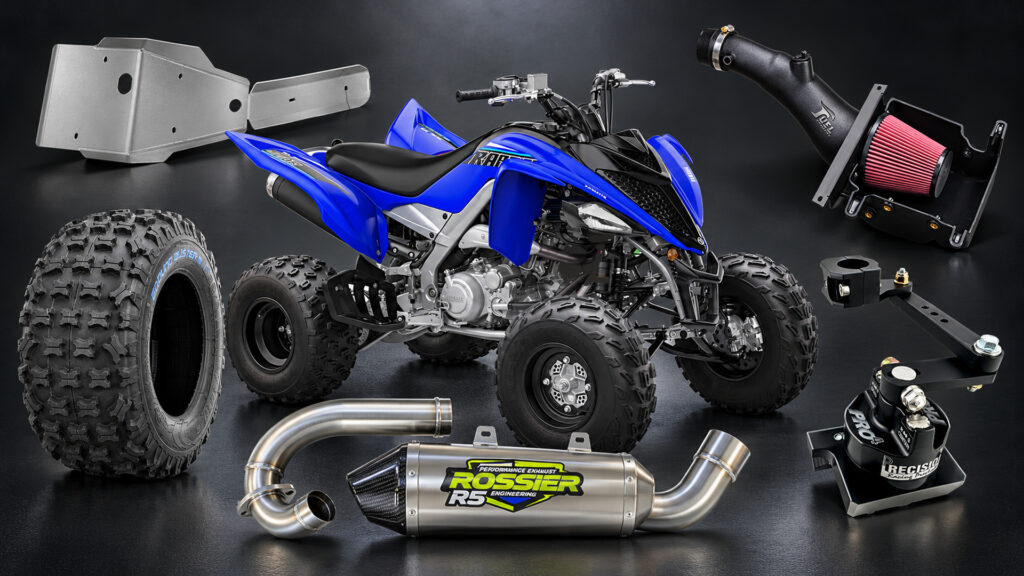

The Yamaha Raptor 700R is arguably the greatest open-class sport ATV ever produced, out of the box. But there’s always room for improvement. Give it the protection it deserves, sharpen the handling, and unlock the power that’s already in the 686, and you’ve got a machine that does everything it was built to do, only better.
If we were building a dream Raptor, these are the first five upgrades we’d begin with.
1. Case Saver

A case saver ain’t glamorous, but it might help keep a thrown or broken chain from taking out the engine case. For well under fifty bucks, it’s cheap insurance, and it belongs on the machine before the first ride, even if that ride is just up the driveway. A sloppy factory master link is unlikely. It is not impossible. Don’t find out the hard way.
There are two materials available: aluminum and UHMW. Tusk makes a solid entry-level billet aluminum unit.

TM Designworks goes the other direction with UHMW plastic. It’s a bit more expensive, but the material is considered to do better at absorbing the impact of a chain failure with minimum transfer to the case.
https://www.rockymountainatvmc.com/parts/tusk-billet-aluminum-case-saver-p?ref=1102
https://www.tmdesignworks.com/p-1035-atv-case-saver-brpn-ycs-702.aspx
https://www.tmdesignworks.com/p-944-atv-integrated-case-saver-sprocket-cover-brpn-ycc-702.aspx
2. Skid Plates

New sport quads are at or above ten grand now, so we can’t imagine taking one off-road without skid plates. Ricochet Off-Road makes a full line for the Raptor 700R: A-arm guards, frame skid plate, and swingarm guard. We’ve used Ricochet skid plates on multiple builds over the years, made in the USA, consistently excellent fitment and solid protection.
The chassis plate comes in 5052 H-32 aluminum, or a quarter-inch UHMW overlay on the aluminum backing, combining the slickness of UHMW with the rigidity and impact dispersion of aluminum.

The swingarm guard is constructed of quarter-inch 5052 H-232 aluminum, TIG welded, covering the swingarm, brake rotor, rear sprocket, and bearing housing in one piece. Ricochet’s A-arm guards are .160-inch 5052 H-32 aluminum, formed to fit the Raptor’s arms without cutting clearance.
Cross-country racers chasing ground clearance might skip the full swingarm plate for separate sprocket and rotor guards. Trail riders on rocky terrain will want the plate.
https://www.rockymountainatvmc.com/parts/ricochet-full-chassis-skid-plate-p?ref=1102
https://www.rockymountainatvmc.com/parts/ricochet-bullet-swing-arm-guard-p?v=21265&ref=1102
https://www.rockymountainatvmc.com/parts/ricochet-a-arm-guards-p?v=21265&ref=1102
3. Steering Stabilizer
In tighter trails, the Raptor’s precise, agile steering makes it incredibly effective, but it also makes the bike twitchy at high speed. Without power steering you’re taking feedback through the bars: mild tugging on the trail, or a hit that can rip them out of your hands. A stabilizer cuts that fatigue and cushions the catastrophic impacts.
You can add a ton of horsepower and ride it faster for a short time, then ride it for a couple hours and wish you’d spent that money on handling instead. We raced a nearly stock Raptor at GNCC in 2025, and the Precision stabilizer was one of two performance mods on the whole bike. The rest was armor, stock suspension setup, and tires. That’s how important it is.

Precision lets you tune straight line and cornering damping separately. The PRO4 Damper is their current top of the line, with a high-speed fluid valve that reacts to fluid speed instead of pressure, eighty percent better impact damping than the Elite. Bigger shaft, bigger lever, shear bolt tying them together. The practical payoff: you can run it lighter and still get the same protection, so you get lighter steering effort with improved bump absorption.
We ran the Elite, loved it, and never saw a need for a new one. But now that the PRO4 exists, you might as well spend the extra $80 and get the top of the line. If you want a cheaper way in, Precision is still offering the Pro Damper. Or buy used, they’re rebuildable. But be warned, they hold their value extremely well.
https://precision-rp.com/PRO4-DAMPER-MOUNT-RAPTOR-700-ATV-BEST-DAMPER-MADE_p_574.html?AffId=23
https://precision-rp.com/PRO-DAMPER-MOUNT-RAPTOR-700-ATV_p_120.html?AffId=23
4. Tires

Tires are one of the most affordable ways to improve the Raptor’s handling while matching traction to your terrain, intended use, and setup. For most trail riders, the rear we’d recommend is the 20×11-9 GBC Ground Buster 3, the original, not the Pro. It offers great all-around traction with a slightly more rounded head than the GB3 Pro, which gives it a little better bump absorption. The sidewalls flex more than some competitors, which improves compliance, and it’s a relatively light tire, so it won’t sap engine performance.
There’s chatter online about GB3 sidewalls getting cut, but that’s mainly from sharp beadlock ring edges on certain Chinese import wheels, not a real concern with stock wheels or composite rings. All tires can be cut, but this one’s more of a wheel problem than a tire problem.

If you want a tougher tire, consider the GBC XC Master: deeper tread, stiffer build, and it could potentially better withstand abuse. Partly due to its stiffer sidewall compared to the GB3, it doesn’t carry the same reputation for cutting sidewalls on sharp beadlock rings. The flatter profile and stiffer sidewall cost you a little ride quality, and the tire trades some traction in certain conditions, but it gains it back where the deeper tread bites harder. It’s a very good tire at a lower price.

Up front, we’d go with the GBC XC Master for most riders: deeper tread for digging into mud and soft conditions, plus a center tread row that puts more rubber on the ground where contact patch matters. The front tire is directional, and some riders feel it offers better traction in certain conditions depending on which direction you run it. The rear tires are non-directional, so you can rotate them regularly to prolong tread life.
GBC offers larger sizes if you want more ground clearance, but that comes with a stability trade-off.

In the sand dunes, the Raptor 700 is one of the best sport ATVs ever made. The stock tires will get you around fine, but if you want to get the most out of it, add a set of paddles out back and a sand tire up front. A solid pick is the ITP Sand Star, 20×11-9 rear, 21×7-10 front, available in other sizes if you need them. The rear carries eight 30mm V-shaped paddles with mini-scoops between them for quick hookup and acceleration. According to Dirt Wheels, the offset V-paddles bite forward while still letting the quad rotate through corners. The Sand Star fronts, with their dual-ribbed center design, let you carve corners with even greater precision.
https://www.rockymountainatvmc.com/tires-and-wheels/gbc-ground-buster-iii-tire-p?ref=1102
https://www.rockymountainatvmc.com/tires-and-wheels/gbc-xc-master-tire-p?ref=1102
https://www.rockymountainatvmc.com/tires-and-wheels/itp-sand-star-rear-tire-p?ref=1102
https://www.rockymountainatvmc.com/tires-and-wheels/itp-sand-star-front-tire-p?ref=1102
5. Big-3 Engine Upgrades
While the Raptor is very rideable, and still fast, in stock trim, it’s leaving a ton of horsepower potential and a broader RPM range on the table.
Stock, a Raptor 700R produces almost as much torque as a fully built 450 race motor. That torque makes it very effective as long as you short-shift. The mid-range is strong, but it signs off early.
To truly unlock its upper mid-range and top-end potential, while gaining an additional generous increase in low-end power, you address the engine as one system. These days the external engine upgrades are commonly handled at once, referred to as the Big Three: exhaust, intake, and fueling.
From our former Big Three test of the Raptor 700 back in 2021, the gains were obvious. According to Garrett Torres at Fuel Customs, a Gen 1 Raptor, 2014 and earlier, moves from about 41 to 42 horsepower stock to 53 to 54 with the big-3. On the Gen 2, 2015 and newer, expect a similar jump, roughly 45 horsepower stock to 54 to 55, thanks to its higher compression ratio.
Exhaust

The first thing people think of when it comes to horsepower upgrades is the pipe. Rossier Engineering has been building high-performance four-stroke pipes for decades, and their R5 and R6 exhausts possess some of the latest in design and technology for the 700.
We know from testing on the Gen 1 Raptor that a dual exhaust provides a bit more over-rev on the Gen 1 Raptor. The historic drawback was the extra silencer weight. Rossier now offers the R5 exclusively as a dual system with stainless steel headers and full titanium silencers, giving you the performance benefit of a dual exhaust with a weight more in line with a single.

With a single exhaust port, the Gen 2 Raptor doesn’t pick up the same advantage from a dual that the Gen 1 does, so Rossier’s Gen 2 systems are singles. The R5 is best suited for Big Three setups and lightly modified engines with mild to intermediate camshafts and compression ratios. The new R6 was developed more for built motors, super high compression, high-lift cams. It uses a larger-diameter head pipe and a dual-outlet silencer to better balance peak horsepower with low-end torque and throttle response. Both the R5 and R6 for the Gen 2 are available in full stainless or titanium. Carbon fiber end caps come standard on all of them.

Once you go to an exhaust, most riders also add an AIS delete. Air is introduced at the head, and blocking it off helps eliminate popping on deceleration. Cuervo Racing makes a simple plate for the Raptor, inexpensive, made in the USA, and it does the job.
https://www.rossiereng.com/product/r5-stainless-exhaust-raptor-700r/
https://www.rossiereng.com/product/r5-titanium-exhaust-raptor-700r/
https://www.rossiereng.com/product/r5-raptor-700r-dual-stainless-steel-system-titanium-mufflers/
https://cuervoatv.com/parts/ols/products/raptor-700-ais-plate-pop-stop-2015-2027-
Intake

On some machines, adding an intake is an essential part of maximizing horsepower gains from bolt-ons. The Raptor is one of them. Fuel Customs’ tapered intake tract is built to increase air velocity and carry the power farther into the over-rev. If you already have an aftermarket exhaust and tuner, adding the Fuel Customs intake adds up to 3 horsepower at peak and up to 6 horsepower in the over-rev.
The kit ships with a pleated filter. That filter is fine for the dunes. It won’t pack with sand the way foam will. If you ride in dusty or silty conditions where fine particles float in the air, pick up the foam Outerwear. It filters those particles more efficiently than cotton.
Fuel Customs offers the kit two ways: with their airbox or without. Some riders, mostly duners, prefer to go without. We always run the airbox. It offers extra protection from flying debris and light splashing, and it doesn’t cost you horsepower. It’s the system we’d recommend for the trail.
Fueling
Increasing airflow through the engine requires more fuel and there are three ways to balance the air/fuel ratio. A stock ECU reflash is what it is. You send the ECU in and get a map designed to match your intake and exhaust. Check with a tuner on your exact setup before committing. Reflashes are limited to mild motor mods, and you have no ability to tune it once it’s back. If the map is off, it goes back for another flash.
A complete aftermarket ECU typically runs eight hundred and up, approaching a thousand. Most years of the Raptor 700 also require modification of the wiring harness, adding cost and complexity beyond the price tag. Vortex units have some onboard tuning, but anything beyond that takes a tuner with a dyno and the software. They’re the more expensive option, claimed to offer the best throttle response and performance if you have the budget and the tuning capability to get it dialed.

The most common route is a piggyback tuner. The Dynojet Power Commander 6 plugs into the stock harness with no wiring mods and no ECU surgery. Pull it out and the Raptor reverts to stock. It ships with maps for popular intake and exhaust combos, and hundreds more are downloadable online. You can add or reduce fuel and timing. Two maps live onboard, switchable on the fly. You can write custom maps on a laptop, with or without a dyno. It can add horsepower from a stock engine all the way up to full race builds, up to the limits of the stock fuel injector.
Conclusion
Our top five upgrades sound easy and doable, but we get it, there’s a lot of expense packed into this list. If we were taking it in chunks, we’d look at it like this:
- Add your case saver and skid plates before your first break-in ride. Even if you’re seasoned and riding at a casual pace, this protects your investment during the most vulnerable period.
- The steering stabilizer comes next, more control and protection for the rider as speeds increase.
- Tires after that, to maximize the Raptor’s handling. It’s considered a weaker point than the engine. If you can afford them alongside the stabilizer, great. Otherwise, this is where you save up for the Big Three.
- The Big Three last, the most expensive, and the most satisfying.
In the end, if you do all of these, you’ve got a Raptor that does everything it was built to do, only better.
Want more Raptor 700 upgrade guides, project builds, and tests? Subscribe to our newsletter and we’ll keep you posted.
Related Content
Yamaha YFZ450R Top-5 Must-Have Upgrades