
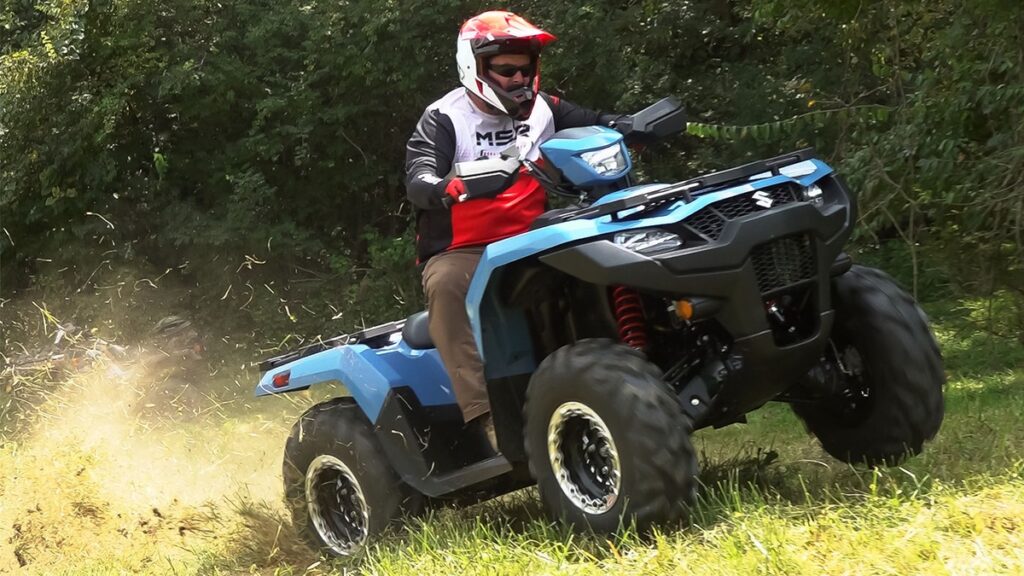
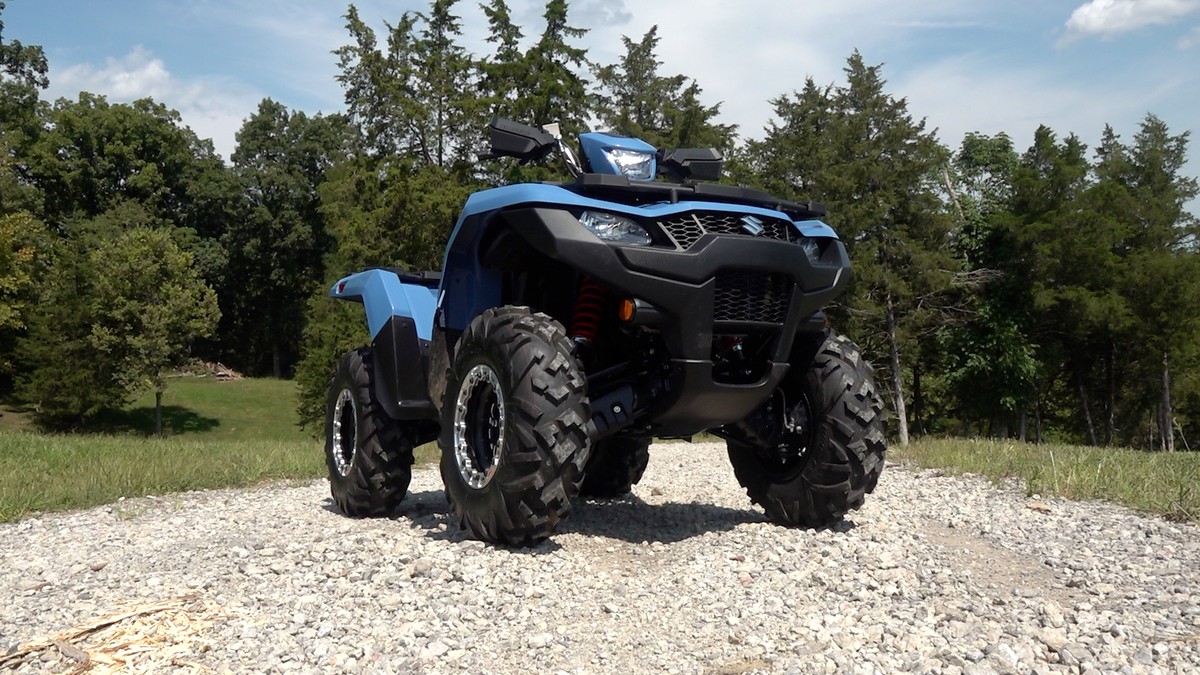
The Suzuki KingQuad 750 has long been a dependable sport-utility 4×4, and perhaps a bit underrated. In our recent 700cc, single-cylinder 4×4 shootout, it finished second in the timed cross-country loop. That result left us wondering how much more we could get out of it for aggressive trail riding or perhaps cross-country racing with just a few bolt-ons.
We fitted OMF beadlock wheels and OBOR Howler tires in a square setup to widen the stance, then added an HMF Titan Quiet slip-on and HMF Fuel Optimizer to wake up the power and help maintain the KingQuad’s strong power-to-weight ratio.
Test Rider and Location
Casey Meyer, one of our riders from the 700cc shootout, ran this test on his hilly private property in Southeast Indiana, the same venue as the shootout.
Handling Upgrades
OMF Wheels
To improve handling, we went with OMF Billet Center Series 12-inch beadlock wheels. They’re USA-built, race-proven, and the wheel size most racers use. We ordered their Type-R Lite centers, powder-coated and billet-cut. They feature spun aluminum barrels and CNC billet components. Reinforcing rings are built to take 4×4 weight and power through the rigors of aggressive riding or racing. Beadlock rings use Super Light Drain holes, scallops, and Super Light Pockets to cut weight without giving up strength.
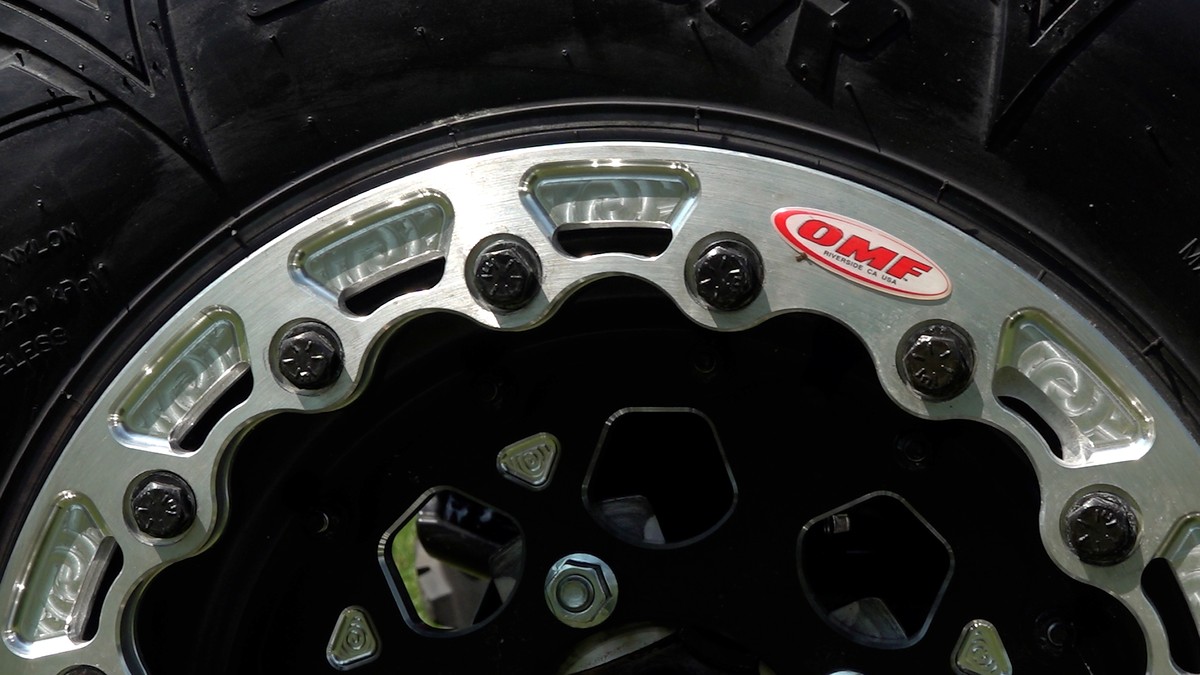
For our needs the most useful feature is offset adjustability. Mounting the center inside or outside the barrel changes offset by three-quarters of an inch. OMF tells us, even at the widest setting the offset stays positive, so steering effort and bump feedback stay reasonable.
As tested, rear track went from 46 to 46.5 inches. The stock front end sat around 45 inches and opened to 48 inches, about three-quarters of an inch per side wider than the rear. That’s not extreme. If it turns out to be too much, the same wheels let us pull the front back in by three-quarters of an inch per side, providing a more even track width that’s still around 1.5 inches wider than stock up front.
OBOR Howler Tires
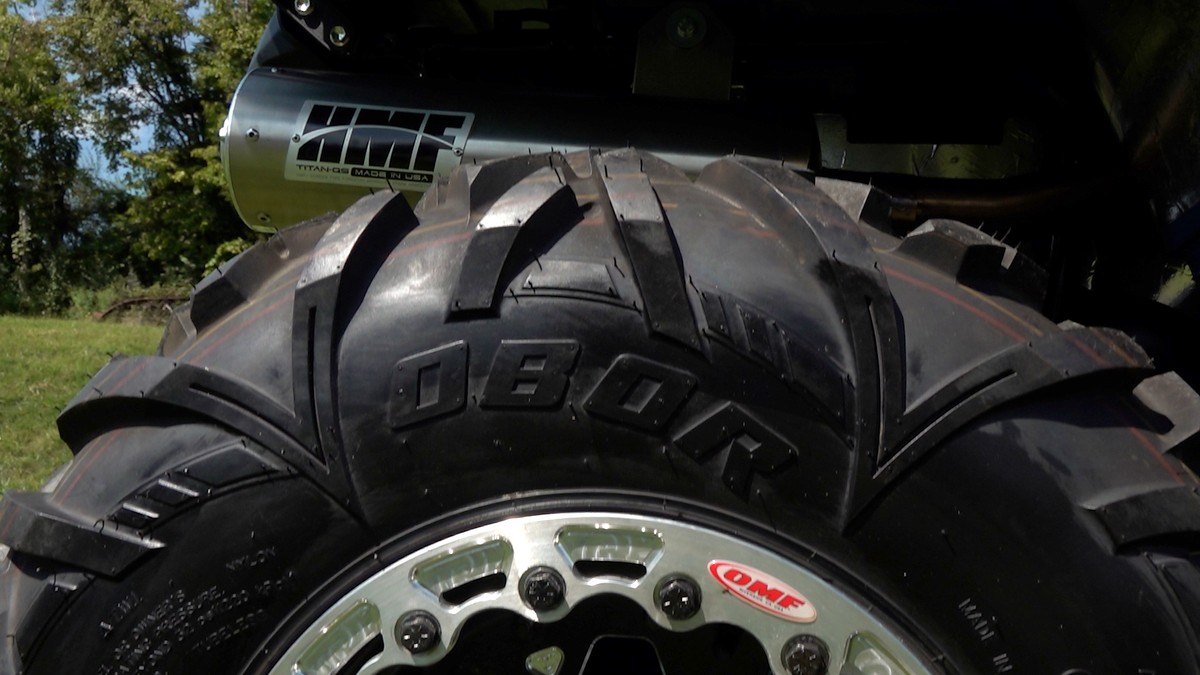
For tires, we chose 25×8-12 OBOR Howler 6-ply radials, a tire former pro 4×4 GNCC racer Landon Wolfe used to capture championships. On a single-cylinder, roughly 50-horsepower KingQuad, weight matters. OBOR claims these radials are light, and the radial carcass should reduce small-bump feedback, important on a machine with limited suspension travel. Tread depth is 24/32 inch, deeper than a lot of popular multi-terrain trail tires.
With non-directional tread and a square wheel-and-tire package we can swap them front-to-rear and side-to-side to stretch tread life.
Horsepower Upgrades
HMF Titan Quiet Exhaust
In the 700cc 4×4 shootout the KingQuad 750 had the second-best power-to-weight ratio in the group. Low-end torque was best in class; mid-range and top end were a little flatter. We wanted more there after hanging a heavier, racier wheel-and-tire package.
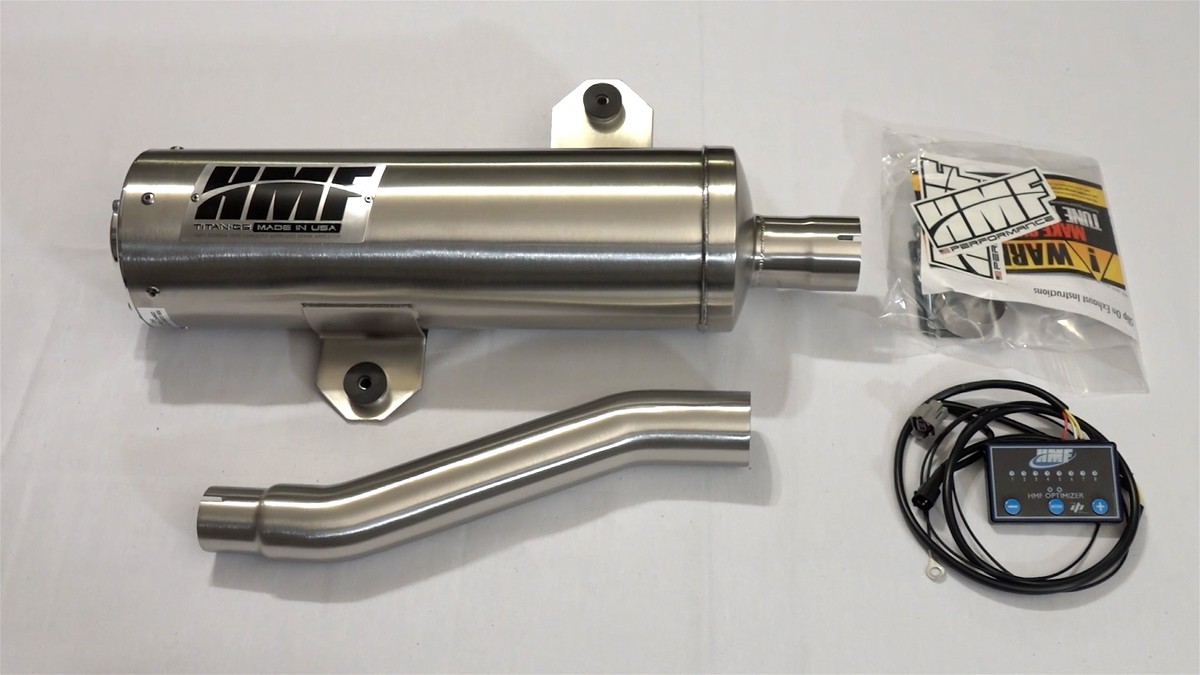
HMF offers several slip-on exhausts for the KingQuad 750; they use the stock head pipe. We installed the Titan Quiet. HMF claims that pairing their exhaust with the fuel optimizer can add 10 to 15 percent horsepower. The Titan Quiet is claimed to be only 1 to 2 decibels louder than stock.
Stainless construction is durable and easy to clean. It will bronze with heat cycles. HMF also offers a heat-resistant gray gunmetal finish if you want a more consistent look.
HMF Fuel Optimizer
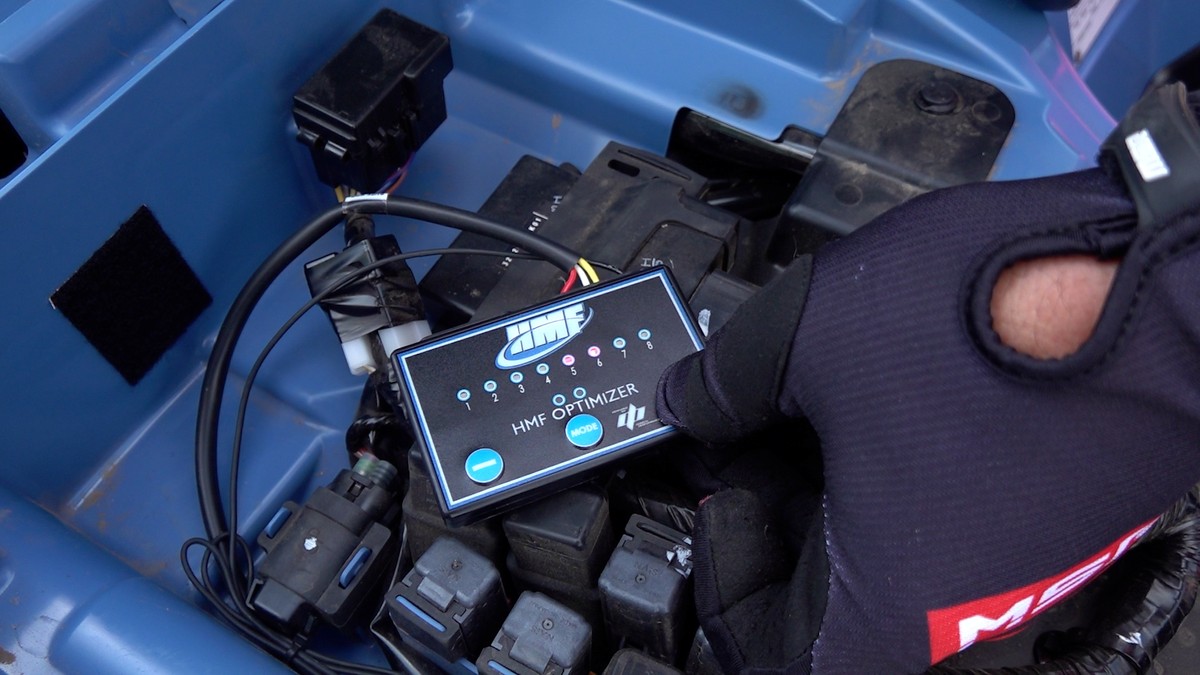
Changing exhausts increases airflow, requiring additional fuel to prevent running lean and potentially damaging the engine. We added HMF’s fuel optimizer, pre-mapped for the KingQuad 750 with their exhaust. On-board push-button tuning allows easy adjustment for altitude or setup changes. No laptop required.
Trail Test
The stock KingQuad exhaust is one of the best-sounding in the class: muscular without being too loud. The Titan Quiet builds on that with a deeper, throatier tone that’s punchier, but it’s barely louder than stock. Unlike most race exhausts, it doesn’t add a bunch of volume.
From our previous testing with stock tires, the HMF exhaust delivers a pretty linear gain, most noticeable in the mid-range. Even with a weight-conscious wheel and tire package, there’s still an increase in rotating mass over the stock non-beadlock wheels and much thinner, less aggressive, albeit lighter OEM tires. That added mass is most noticeable when you’re just getting rolling. The OBOR tires run about a half inch shorter than stock, which helps offset the weight some by effectively lowering the machine’s gearing a small amount.
Low-RPM acceleration is where the added rotating mass shows up most. The KingQuad’s class-leading low-end power feels marginally less impressive with the heavier wheel and tire package, but it’s still strong and impressive for the class.
In the mid-range and top end, the added power of the HMF exhaust and fuel optimizer did a respectable job of maintaining and perhaps improving acceleration out of corners. On long, steep hills where the engine was heavily loaded, the gains were more noticeable. The KingQuad still hauls the mail up the climb, holding speed and building momentum without feeling taxed. Under that kind of load it actually feels more impressive than stock, despite the added rotating mass.
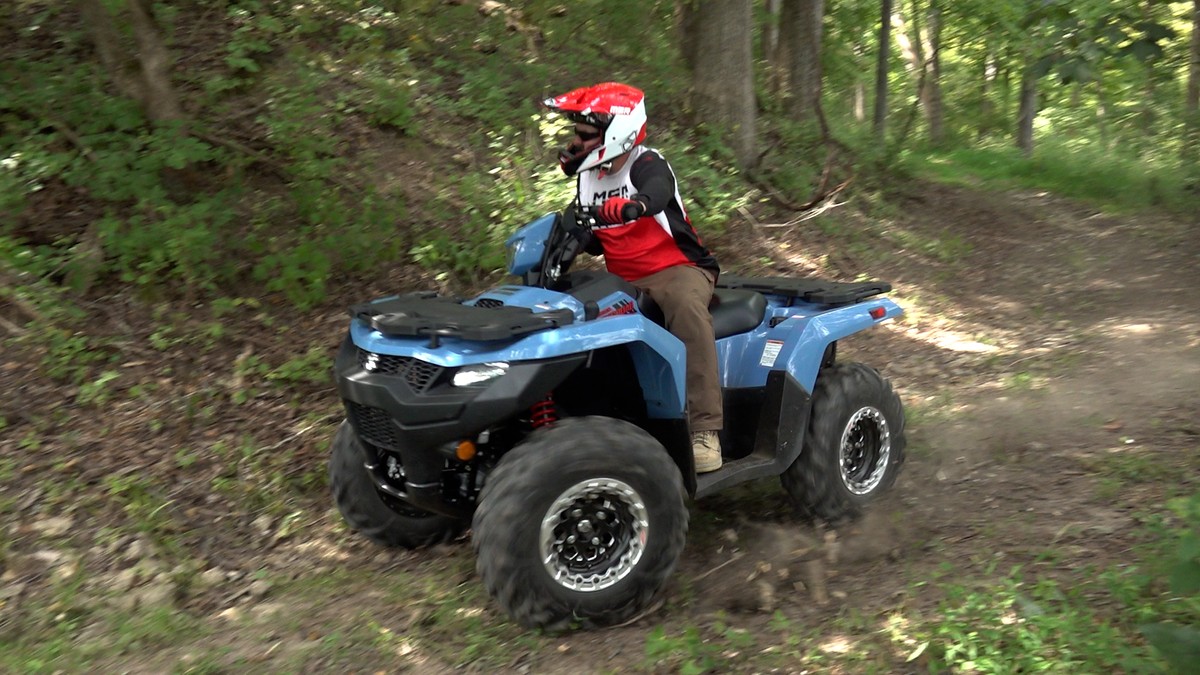
The HMF Titan Quiet exhaust and fuel optimizer were a great way to offset the added weight of the wheels and tires, letting us take more advantage of the handling improvements they provide.
From race testing early in the KingQuad’s life, we know an aftermarket clutch kit is the next step. It raises RPM on takeoff, gets the machine revving faster, and takes full advantage of the exhaust’s horsepower increase.
Handling
The OMF wheels and OBOR tires delivered all the handling gains we were looking for with little drawback. The KingQuad was notably more stable in downhill off-cambers, making us considerably more confident. We didn’t need to shift our weight as much to keep it planted, and that made the whole ride more enjoyable.
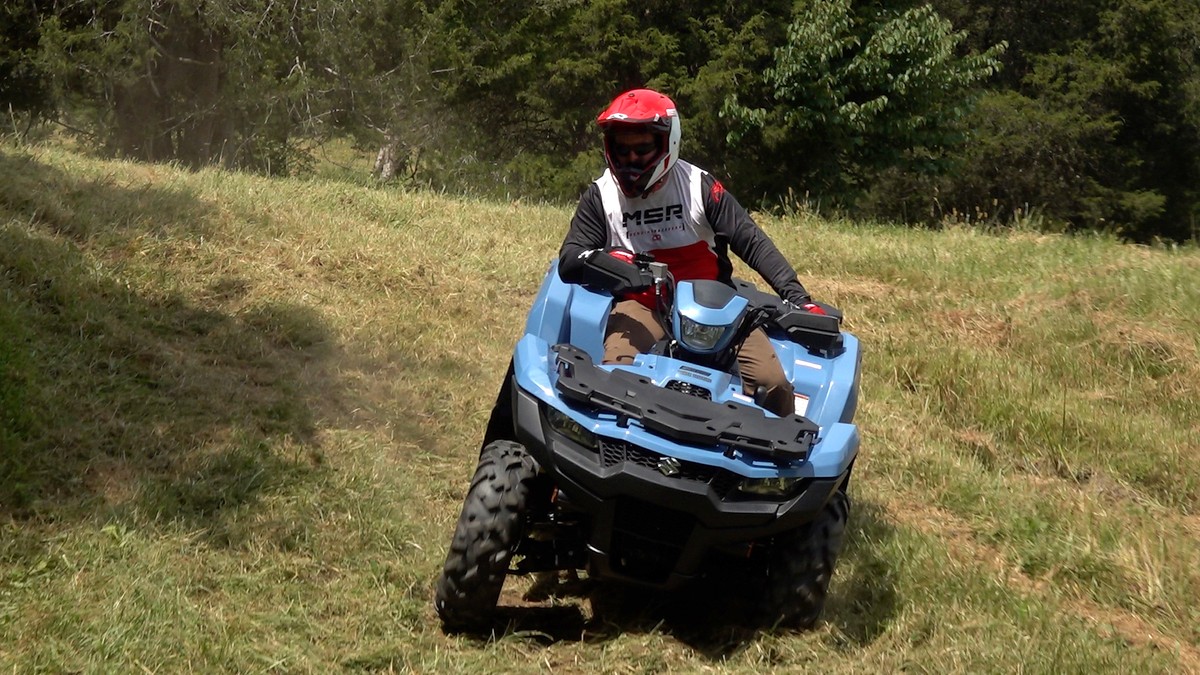
Once we aired the tires down to around five pounds each, appropriate for the intermediate trail speeds we were hitting, the radial tires did a superior job of absorbing small bumps with less bounce than stock. The added leverage of the wider wheels softened the ride a touch compared to stock. It was slightly plusher, but still firm, and not a problem in corners, flat sections, or off-cambers. We only felt the front end bottom once all day, and we wouldn’t touch the suspension as-is. It worked well with this setup. If we needed to stiffen things up for any reason, there’s still adjustability left in the shocks.
Casey had no quarrels with the setup as tested. I hopped on at the end of the day and loved the stability gains, but I noticed a bit more low-speed steering feedback under acceleration, especially in four-wheel drive, where the outside tire feels like it’s pulling through the bars. High-speed bump filtration didn’t seem much different; it was more of a low-speed tug. My takeaway: I’d bolt the front centers to the outside of the barrel, pulling the front track in three-quarters of an inch per side to roughly forty-six and a half inches, still an inch and a half wider than stock and halfway between stock and as-tested. That would give a better balance of added stability while retaining a steering feel closer to stock. Casey’s fine with it as-is; I’d make that one small adjustment.
Front-end grip seemed mildly improved. The higher-traction OBOR tires still put up a fight when breaking the rear end loose, but the added width and power allowed Casey to coax the rear end around a bit easier than stock.
Under braking on long, loose, rocky downhills, the OBOR tires delivered notably more traction and therefore stopping power. Their improved grip came from the combination of tread depth and design plus the tire’s less bouncy behavior.
Conclusion
While regarded as a dependable workhorse for years, the KingQuad’s reputation for performance had been lost in the shuffle due to lack of changes and new offerings in the segment. But the shootout showed it still had the goods: best-in-class low-end torque, a power-to-weight ratio near the top of the class, and the second fastest time in the cross-country loop. Its biggest hindrance was its width, as the narrowest in the class. That was easily remedied by the OMF wheels and OBOR tires, which improved stability and ride quality. The HMF Titan Quiet exhaust and fuel optimizer improved horsepower, helping maintain the Suzuki’s good acceleration with the more robust wheel and tire package.
With a handful of more mods, including a clutch kit, skid plates, and a winch, you could build it into a bomb-proof trail rig. Or strip it down, add a set of Elka shocks, a kill switch, and take it cross-country racing. Either way, this project left us even more excited about Suzuki’s good old KingQuad 750.
KingQuad 750 Upgrade Products and Prices
| Product tested | Manufacturer and price |
|---|---|
| OMF Billet Center Series 12-inch beadlock wheels with Type-R Lite centers | OMF Performance Contact manufacturer for price. |
| OBOR Howler 25x8R12, 6-ply radial tire | OBOR Howler Contact manufacturer for price. |
| HMF Titan Quiet slip-on for Suzuki KingQuad 750 | HMF Racing Contact manufacturer for the tested configuration’s price. |
| HMF Fuel Optimizer for Suzuki KingQuad 750 | HMF Racing $314.95 USD each. |
Price shown is from the manufacturer website, checked November 6, 2026; taxes and shipping excluded. Confirm current pricing, configuration and model-year fitment with the manufacturer.