Published on December 22nd, 2025 | by Joe
2026 Can-Am Outlander 700 XT Test Review: WITH VIDEO
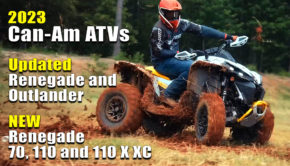
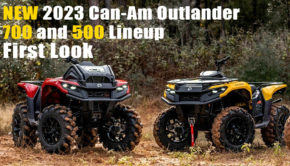
Back in 2023, Can-Am launched a brand-new Outlander 700 and 500 lineup, touting class-leading specifications, and ATV On Demand was there to put it to the test. Testing at high altitude—where Can-Am told us we were losing around 20% horsepower—definitely impacted performance. We were impressed by the handling, but our testing location didn’t provide the roots and rocks common on many trails. Because of this, we couldn’t fairly evaluate how the suspension handled small-bump compliance, which can wear on riders during long rides.
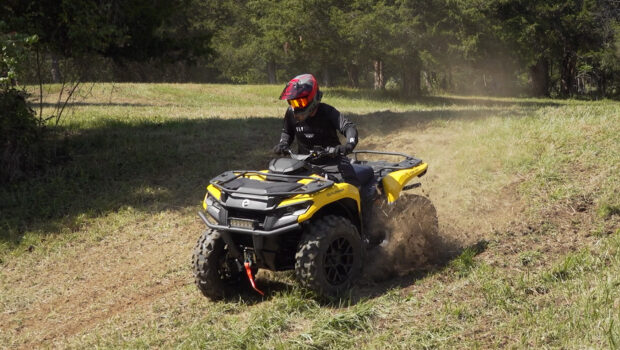
For this 2026 test, we’re back to evaluate the Outlander 700 on more realistic trails at a lower altitude to better experience the engine’s claimed 50 horsepower. The tighter, root- and rock-strewn trails will let us better evaluate handling and suspension performance. While we’re testing the original 2023 Outlander 700, provided by Can-Am (as no later models were available), we’ll also reference our testing of the 2023 Outlander 700 Pro to assess updates like Intelligent Throttle Control (iTC) and Intelligent Engine Braking (iEB), introduced in 2024.
So, how does the Outlander 700 perform in real-world conditions? Let’s ride and find out.
Trim Packages
Outlander 700 (Base Model)
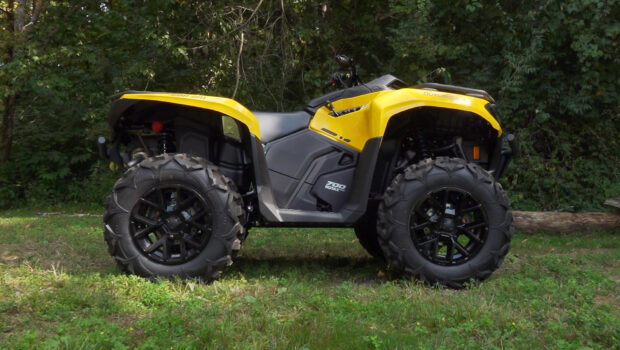
Retailing for $8,149, the 2026 Outlander 700 serves as the base model in the lineup. It comes equipped with a Visco-Lok auto-locking front differential, 25-inch tires on 12-inch steel wheels, a full chassis skid plate, a glovebox, and front drop-down storage but lacks some of the upgraded features found in higher trims.
Outlander 700 DPS
Stepping up to the Outlander 700 DPS at $9,199, It gains a Visco-Lok QE, (quick-engaging,) auto-locking front differential for enhanced traction in challenging terrain. It also features Tri-Mode Dynamic Power Steering (DPS), offering three levels of assistance to suit different speeds, conditions, and use. The DPS trim further includes Intelligent Throttle Control (iTC) with Work, Standard, and Sport modes to optimize throttle performance for different riding needs.
Outlander 700 XT
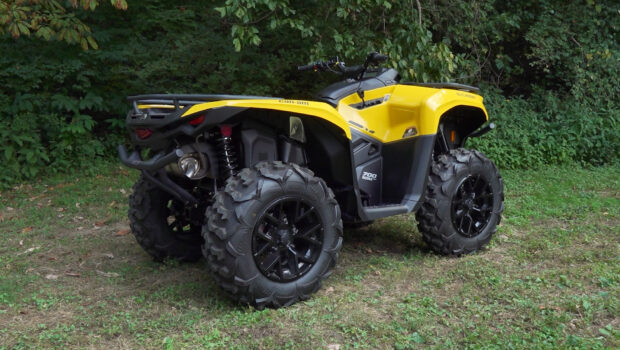
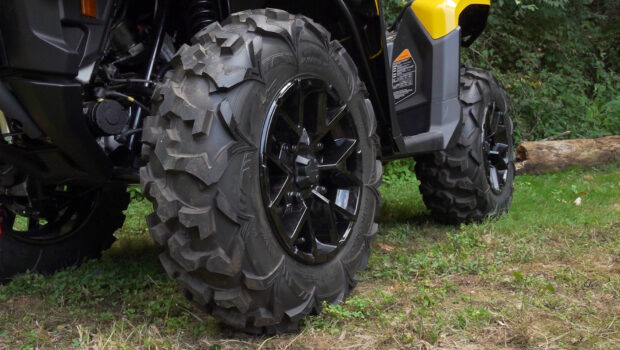
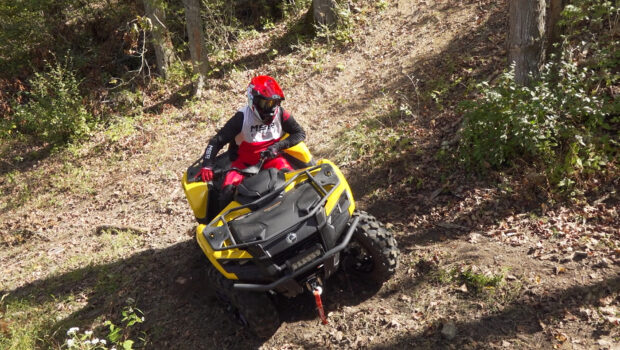
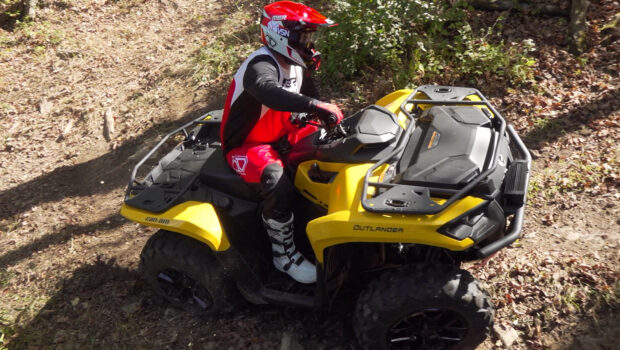
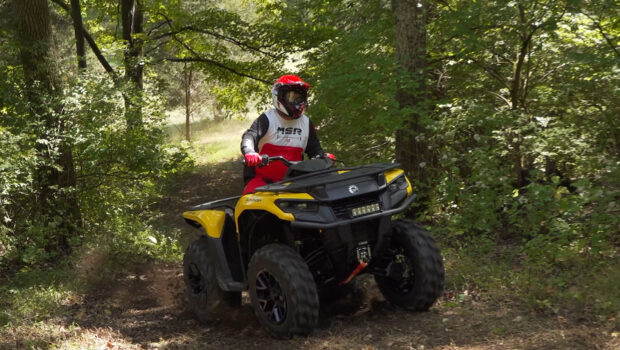
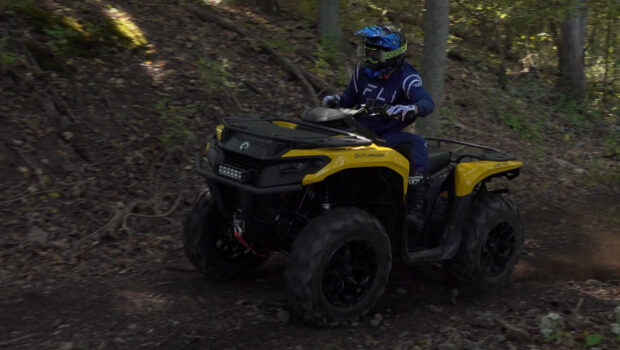
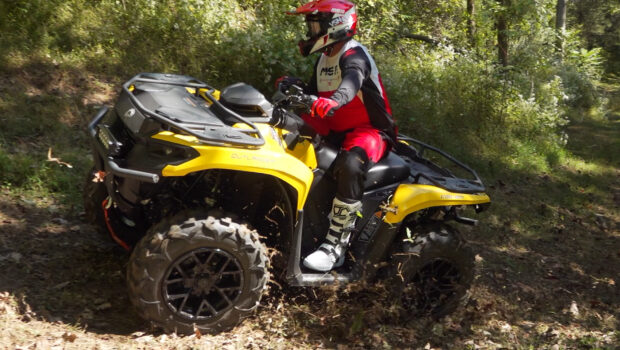
At $10,249, the Outlander 700 XT takes performance and capability to the next level. Along with Tri-Mode Dynamic Power Steering (DPS) and Intelligent Throttle Control (iTC), it adds three levels of selectable Intelligent Engine Braking (iEB) for more precise deceleration control. The XT features 26-inch XPS Trail Force tires, one inch taller than those on lower trims, mounted on 14-inch aluminum wheels. Extra protection is provided by front and rear steel bumpers and a 3,500-pound winch offers enhanced recovery and work capability.
Riders and Location
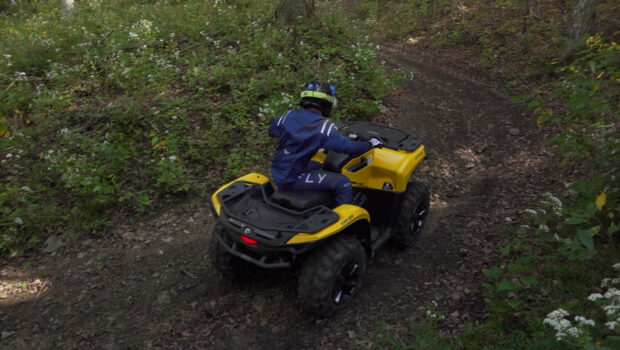
Our Outlander 700 XT test took place on a hilly property in West Harrison, Indiana. Riders included former pro ATV MX racer Aaron Meyer, heavy equipment operator and long-time 4×4 ATV owner Casey Meyer, 450cc sport ATV XC racer Isaac Hart, and C-class 4×4 GNCC racer Landon Dean.
Engine Performance
The 2026 Can-Am Outlander 700 XT is powered by a 650cc, single-cylinder, liquid-cooled engine with a four-valve, DOHC head design. The engine uses Electronic Fuel Injection (EFI) with a 46mm throttle body and is claimed to produce 50 horsepower and 41 lb-ft of torque. While horsepower is among the best in its class, the XT’s claimed dry weight of 858 pounds gives it a slightly lower power-to-weight ratio than some competitors.
Starting in 2024, the engine was paired with a drive-by-wire throttle. The Intelligent Throttle Control (iTC) system offers three modes—Work, Standard, and Sport—providing unique throttle characteristics for different terrain, riding styles, and conditions. All three modes deliver full throttle at full throttle.
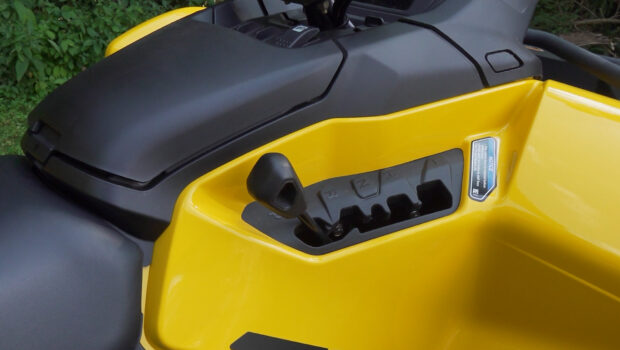
The engine connects to a pDrive clutch-equipped CVT transmission, offering Low, High, Neutral, Reverse, and Park, selected by a gated shifter. The drivetrain features selectable 2WD/4WD with Can-Am’s Visco-Lok QE auto-locking front differential, which provides limited-slip four-wheel drive until one front wheel begins to spin, automatically locking both front wheels for maximum traction. Starting in 2024, the Outlander 700 XT also received Intelligent Engine Braking (iEB) with three levels of engine braking for different type of riding and use.
The engine turns over pretty slowly. It starts quickly, when cold but takes a bit longer to fire when hot. When running, EFI tuning seems spot on.
Low-end and midrange power are smooth and manageable, offering a mellow, controllable pace, welcomed on tight trails or casual rides. From midrange to top-end, the engine really wakes up, revving fast and delivering an exciting burst of power that’s arguably the strongest in its class. Intelligent Throttle Control’s Sport mode makes that strong upper-mid and top-end power accessible earlier in the throttle throw. Even considering its heavier weight, the XT feels lively, while the lighter 700 DPS would likely feel even quicker for riders focused on acceleration.
The gated shifter’s operation is smooth and flawless, even on hills. Can-Am’s pDrive transmission provides nearly seamless acceleration and responsive throttle feel, maintaining consistent power delivery. Engine braking is smooth and predictable, and selectable Intelligent Engine Braking allows fine-tuning of deceleration feel. The Visco-Lok QE front differential engages reliably, locking in both front wheels for optimal traction when needed—though riders noted a faint knocking sound when it engages. Overall, the powertrain delivers excellent performance.
Handling and Suspension
The Outlander 700 XT rides on a steel chassis protected underneath by a 5.5mm HMWPE plastic skid plate, claimed to be 40% thicker than the competition. Pre-drilled holes simplify maintenance.
The front suspension features dual A-arms raked for improved bump absorption, with arched lower arms for better ground clearance. The rear end also uses a dual A-arm design. Rubber bushings throughout reduce chassis noise and increase longevity, while a rear sway bar minimizes body roll.
Suspension travel is class-leading, with 9.75 inches up front and 10.25 inches rear, both managed by preload-adjustable, twin-tube, gas-charged shocks. The Tri-Mode Dynamic Power Steering (DPS) system offers three levels of assistance.
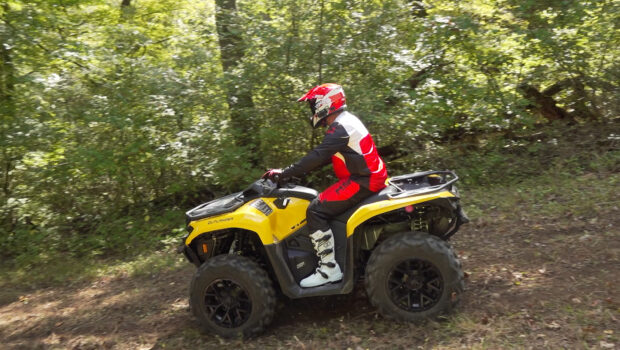
The XT’s 26×8-inch front and 26×10-inch rear XPS Trail Force tires mounted on 14-inch cast aluminum wheels provide 12.5 inches of ground clearance, the most in the class. Its 53-inch wheelbase and 48.8-inch width—thanks to increased wheel offset—make it 1.2 inches wider than the base and DPS models. Seat height is 38.6 inches, compared to the lowest in class 34.8” for the Honda Rubicon 700.
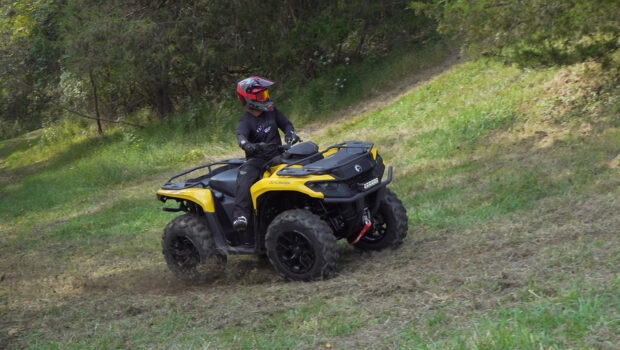
The Outlander’s suspension delivers a plush ride across small and medium bumps, while maintaining strong resistance to bottoming out on big hits or jumps. Even when bottoming the front or rear, impacts feel controlled rather than harsh. The setup allows full use of travel while remaining composed—a trait that separates it from some shorter-travel competitors.
For Outlander 700 or 500 owners, upgrading to a set of shocks from ELKA Suspension with adjustable damping would allow you to make the shocks feel bottomless on bigger hits and better adapt the ATV for various cargo loads. Elka shocks are completely serviceable and rebuildable, unlike the stock shocks, so their superior performance can be maintained for the life of your ATV. Shop Elka Suspension’s offerings for the Outlander 700 and 500 at elkasuspension.com.
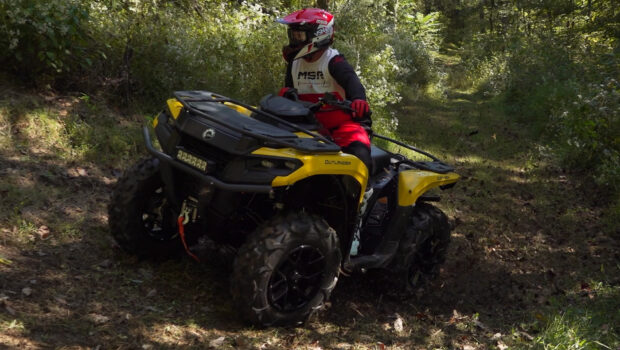
Despite its comfort, body roll is minimal. Combined with its wide footprint and long wheelbase, the Outlander is exceptionally stable in corners and on sidehills. Steering precision is excellent at all speeds, with a tight turning radius despite its size. The Tri-Mode DPS allows riders to customize steering effort—light at low speeds and stable at higher speeds. The only drawback is weight: the XT feels notably heavier than the much lighter, Grizzly 700, making fast descents or sharp cornering slightly more demanding. Still, its balance of plushness, stability, and control make it one of the best-handling ATVs in its class.
Brakes
Hydraulic disc brakes are used at both ends, with dual 214mm front rotors and a single 214mm rear rotor, each paired with dual-piston calipers. The lefti handlebar lever operates both front and rear brakes simultaneously, while the right foot pedal controls the rear brake independently.
Braking power is strong, though front-end bias with the single-lever system can make the use of the rear brake pedal necessary to maximize stopping performance. The rear brake pedal is a bit high and modulation in 4WD takes some finesse. Once mastered, braking performance feels solid and predictable. If we could improve one feature, it would be adding separate front and rear brake control for finer modulation.
Ergonomics and Other Details
Ergonomics are excellent, though the ATV feels large overall. The tall, well-padded seat and slim midsection create a comfortable, secure riding position. Smooth side panels make it easy to grip the machine or shift body weight for cornering.
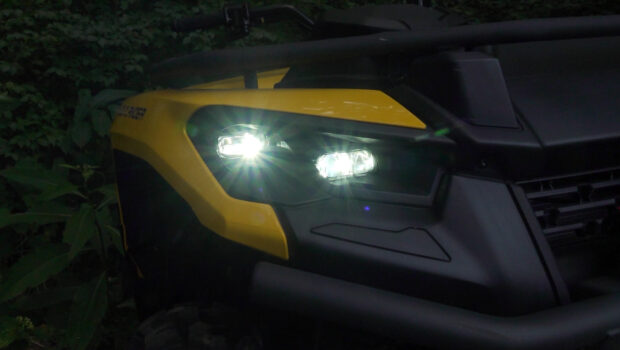
The handlebars feel low and sporty, with Can-Am uniquely mounting the display in front of the handlebars, allowing easy customization with aftermarket bars. Switches, levers, and grips feel high quality, and the full LED lighting delivers outstanding visibility, making auxiliary lights like the light bar found on our machine optional. Can-Am’s attention to fit, finish, and design details have certainly improved on the Gen 3 Outlander lineup.
Utility Capability
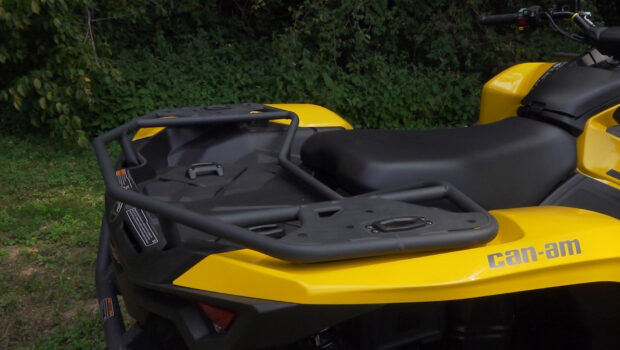
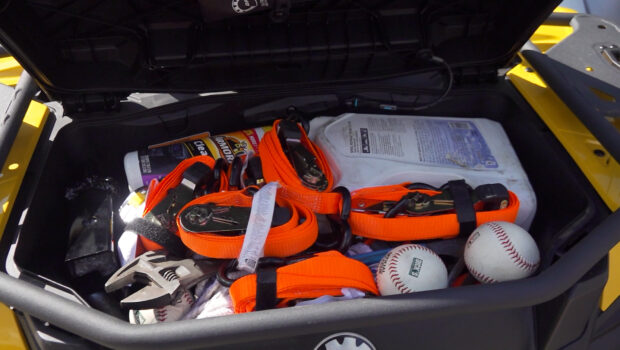
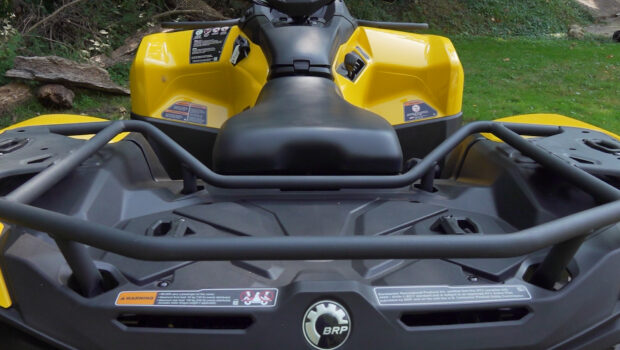
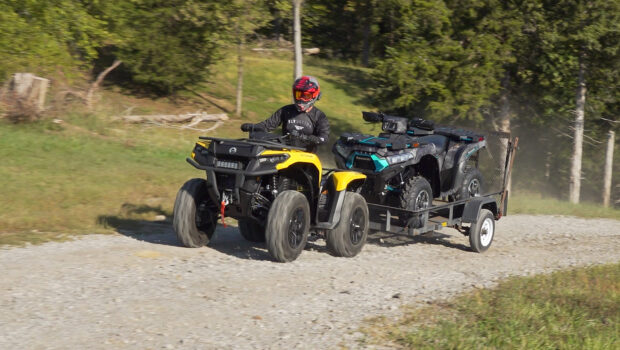
Utility capability stands out, with towing and hauling performance that leads the sub-50-inch ATV segment. Rack capacity is rated at 120 lbs up front and 240 lbs at the rear, while the 2-inch hitch receiver is capable of towing up to 1,830 lbs. Can-Am sets itself apart with a sturdy 9-gallon front storage box, which feels more durable than Polaris’ comparable front rack/cargo system. The lid can be removed to create an open storage area that fits neatly inside the steel perimeter rack. Out back, a steel perimeter rack surrounds an open-bed design—similar to a scaled-down SxS rear bed—ideal for carrying a cooler or gear without awkwardly strapping items to the top of rack. Between the rider’s knees, a sealed storage box includes a USB port for convenient phone charging. As delivered, Can-Am’s unique approach to integrated storage and hauling deserves praise for its practicality and innovation.
In use, its work performance is exceptional. Loaded with 100 lbs on the front and 150 lbs on the rear rack, we increased the shock preload to handle the added weight. The ride stayed stable and compliant, with ample suspension travel remaining. For towing, with the front shocks set softer, the Outlander’s long wheelbase and XPS Trail Force tires maintained excellent directional control , confidently towing over half a ton up and down steep gravel grades.
Although low-end power is more subdued, the transmission’s low range provides plenty of leverage for moving heavy loads without excessive revving. Overall, this may be the hardest-working ATV in its class—proving it works just as hard as it plays.
Conclusion
We loved the Outlander 700 at Can-Am’s 2023 press intro, and after riding it on real trails at lower altitudes, we love it even more! It’s quick, comfortable, and versatile—with excellent suspension and handling, good braking, and standout utility performance. If it shed about 150 pounds, its dominance would be unquestioned. As it stands, the 2026 Can-Am Outlander 700 XT remains one of the most complete, well-rounded ATVs in its class—and a top contender in our upcoming 700cc 4×4 ATV Shootout.

Related Posts
2026 Honda Rubicon 700 4×4 Automatic Test Review: WITH VIDEO →
2025 Suzuki KingQuad 750 Test Review: WITH VIDEO →
2023 Can Am Outlander 700 and 500 First Look WITH VIDEO →