
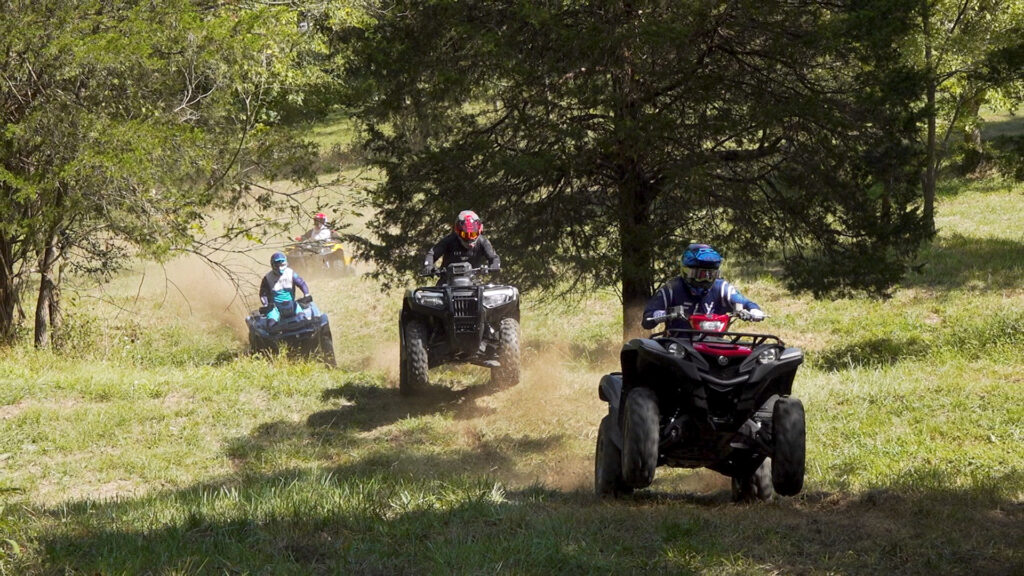
Welcome to ATV On Demand’s 2026 single-cylinder 700cc 4×4 ATV shootout, featuring the Can-Am Outlander 700 XT, Honda Rubicon 700, Suzuki KingQuad 750, and Yamaha Grizzly 700. These machines are trail favorites, blending performance with utility capability.
With GNCC racing adding its sport 4×4 class for single-cylinder machines, these ATVs now carry legitimate race potential. Whether you’re looking for the best trail ripper, a hard-working utility ATV, or a new cross-country race machine, we’re lining the big-bore singles up to see which one comes out on top.
Shop the Gear Featured in This Shootout
Want to run the same type of communication system and riding gear featured in this shootout? Check out the gear links below.
| Featured Gear | Link |
|---|---|
| Cardo Communication Systems | https://cardosystems.com/discount/ATVONDEMAND |
| Fly Racing Gear | https://www.rockymountainatvmc.com/riding-gear/fly-racing?ref=1102 |
| MSR Riding Gear | https://www.rockymountainatvmc.com/riding-gear/msr?ref=1102 |
Some of these are affiliate links. If you use them, we may earn a small commission while you pay the same price.
The Competitors
To keep this shootout fair, we worked to balance features and pricing when choosing trim packages.
The Can-Am Outlander 700 is the newest platform in the group. Introduced in 2023, our test unit is a 2023 model, which Can-Am felt would remain competitive even without the later addition of selectable Intelligent Throttle Control and Intelligent Engine Braking. The Outlander 700 XT package we’re featuring is Can-Am’s top trim in this class, carrying an MSRP of $10,249.
The Honda Rubicon 700 was reintroduced in 2024 as a renamed and refreshed version of the long-running Rincon, originally released in 2003, making it the oldest design in this shootout. The Rubicon 700 is available in a single trim level with an MSRP of $9,999.
The Suzuki KingQuad 750 was first introduced in 2005 as the KingQuad 700 before expanding to 750cc shortly thereafter. Since then, it has seen incremental updates rather than major redesigns, with power steering added in 2009. More recent revisions have focused on addressing earlier shortcomings while enhancing the KingQuad’s long-standing strengths. The KingQuad 750 SE we selected retails for $11,729.
The Yamaha Grizzly 700 traces its roots back to 2007, with Yamaha refining the platform through steady updates rather than full redesigns. A key change came in 2014, when Yamaha widened the Grizzly’s stance alongside suspension and EPS updates to improve stability and handling. The most recent revisions arrived for 2025, including updated power steering assist and accompanying refinements, along with a significant pricing reduction. These updates kept the Grizzly current without altering its fundamental character. The base Grizzly 700 is the most directly comparable in performance to the other machines in this shootout, with an MSRP of $10,399.
Mechanical Breakdown
Engines
All four machines have fuel-injected engines. The Yamaha Grizzly 700 is 686cc, producing 48.3 horsepower with a wet weight of 701 pounds, resulting in a leading power-to-weight ratio of .0689 HP per pound. The KingQuad 750, at 722cc, produces 49.6 HP with a wet weight of 721 pounds, yielding a nearly identical power-to-weight ratio of .0688 HP per pound. The Can-Am Outlander 700 displaces 650cc, producing 50.02 horsepower with a claimed dry weight of 858 pounds, plus roughly 40 pounds for fuel, other fluids, etc. This yields the third-best power-to-weight ratio of .056 HP per pound. The Honda Rubicon 700, at 675cc, delivers 38 horsepower with a wet weight of 701 pounds. It comes in fourth in power-to-weight ratio at .054 HP per pound. Horsepower numbers are according to CARB.
It’s worth noting that there’s an additional 10-15% HP waiting to be unleashed, along with cooler running temperatures, by installing a good aftermarket exhaust like HMF’s Performance or Titan Series exhausts when paired with one of their fuel optimizers. Learn all about what HMF can do for your ATV at hmfracing.com.
All four machines feature four-valve head designs. The Outlander and KingQuad feature double overhead cams, while the Grizzly and Rubicon run single overhead cams. Additionally, the Can-Am Outlander 700 offers multiple selectable throttle modes—Work, Standard, and Sport—whereas the other models come with a single, fixed throttle mode.
Engine Specifications
| Specification | Can-Am Outlander XT 700 | Honda FourTrax Rubicon 700 4×4 Automatic | Suzuki KingQuad 750AXi Power Steering SE | Yamaha Grizzly 700 EPS |
|---|---|---|---|---|
| Claimed Horsepower | 50.02 hp CARB | 38 hp CARB | 49.6 hp CARB | 48.3 hp CARB |
| Engine Type | 650cc Rotax ACE single-cylinder, liquid-cooled | 675cc liquid-cooled longitudinally mounted single-cylinder four-stroke | 722cc liquid-cooled single-cylinder four-stroke | 686cc liquid-cooled single-cylinder four-stroke |
| Bore x Stroke | Not listed by manufacturer | 102.0mm x 82.6mm | 104.0mm x 85.0mm | 102.0mm x 84.0mm |
| Compression Ratio | Not listed by manufacturer | 9.2:1 | 9.9:1 | 10.0:1 |
| Valve Train / Head Design | DOHC, four-valve | SOHC, four-valve | DOHC, four-valve | SOHC, four-valve |
| Fuel Delivery / Induction | Fuel Injected system, 46mm throttle body and Intelligent Throttle Control | Fuel Injection system, 40mm throttle body | Suzuki electronic fuel injection | Yamaha Fuel Injection, 44mm throttle body |
| Selectable Throttle Modes | Work / Standard / Sport | No | No | No |
| Fuel Capacity | 5.1 gal. | 4.4 gal. | 4.6 US gal. | 4.8 gal. |
Drive Trains
All of the ATVs in this shootout except the Honda use fully automatic CVT transmissions with high, low, neutral, and reverse. The Can-Am and Yamaha offer park in the transmission plus parking brakes. The Suzuki and Honda rely on parking brakes exclusively. The Outlander’s pDrive transmission features roller bearings in the clutches to smooth engagement. The Grizzly and KingQuad feature primary centrifugal clutches to handle engagement and disengagement, keeping the belt under constant tension for reduced belt wear. The Rubicon 700 features a three-speed transmission aided by a torque converter. It has push-button electronic shifting featuring manual or automatic modes. Auto can be overridden for a few seconds with push-button shifting if needed.
All of these machines feature engine braking. The Yamaha and Suzuki feature a single mode with more or less braking depending on whether you’re in low or high range. Besides the transmission range, the Can-Am features its three-mode selectable Intelligent Engine Braking, offering different levels of braking. The Honda’s engine braking force depends on the gear you’re in.
Suzuki and Yamaha feature conventional drivetrains with 2WD, 4WD, and 4WD with front differential lock, all operated by similar push-button and switch combinations. The Outlander features 2WD and 4WD with Can-Am’s auto-locking Visco-Lok QE front differential that locks in both front wheels if one starts spinning. The Honda features 2WD and 4WD with its TraxLok torque-sensitive front differential automatically sending power to whichever front wheel is getting traction.
Drivetrain Specifications
| Specification | Can-Am Outlander XT 700 | Honda FourTrax Rubicon 700 4×4 Automatic | Suzuki KingQuad 750AXi Power Steering SE | Yamaha Grizzly 700 EPS |
|---|---|---|---|---|
| Transmission Type | pDrive primary CVT | Three-speed automatic/manual transmission with torque converter | Fully automatic CVT | Fully automatic CVT |
| Transmission Ranges / Modes | L / H / N / R / P | Automatic mode, manual push-button shift mode, reverse | H / L / N / R | H / L / N / R / P |
| Clutch / Engagement System | pDrive clutch system with roller bearings | Torque converter-assisted transmission | Primary centrifugal clutch keeps belt under tension | Primary centrifugal clutch keeps belt under tension |
| Final Drive | Shaft drive | Shaft drive | Shaft drive | Shaft drive |
| 2WD / 4WD Selection | Selectable 2WD / 4WD | Selectable 2WD / 4WD | Selectable 2WD / 4WD | Selectable 2WD / 4WD |
| Front Differential System | Visco-Lok QE auto-locking front differential | TraxLok torque-sensitive front differential | Selectable front differential lock | Selectable front differential lock |
| Engine Braking | Intelligent Engine Braking with selectable levels | Gear-dependent engine braking | Engine braking varies by high / low range | Engine braking varies by high / low range |
| Parking System | Park in transmission plus parking brake | Parking brake only | Parking brake only | Park in transmission plus parking brake |
Chassis and Suspensions
All of these machines are built on steel chassis. The Suzuki and Yamaha feature plastic skid plates on the frame and A-arms at both ends. Honda has under-frame plastic skid plates with driveshaft guards at both ends, offering some A-arm protection. Can-Am has a thick chassis skid plate with no A-arm protection. Suzuki has no front guard, Yamaha has a tubular steel and composite front guard, Honda has a steel front guard, and the Can-Am XT package has front and rear steel bumpers or guards.
All feature fully independent, dual A-arm suspension at both ends. The Outlander has the most travel of the bunch, with 9.75 in. front and 10.25 in. rear. Second in travel, the Grizzly has 7.6 in. front and 9.1 in. rear. Third in travel is the Rubicon 700 with 6.9 in. front and 8.0 in. rear. The KingQuad has the shortest travel of the group with 6.9 in. of travel front and 7.7 in. rear. The Can-Am, Yamaha, and Suzuki feature five-way preload-adjustable shocks. The Rubicon 700’s are not adjustable. All four machines have rear sway bars to help control body roll.
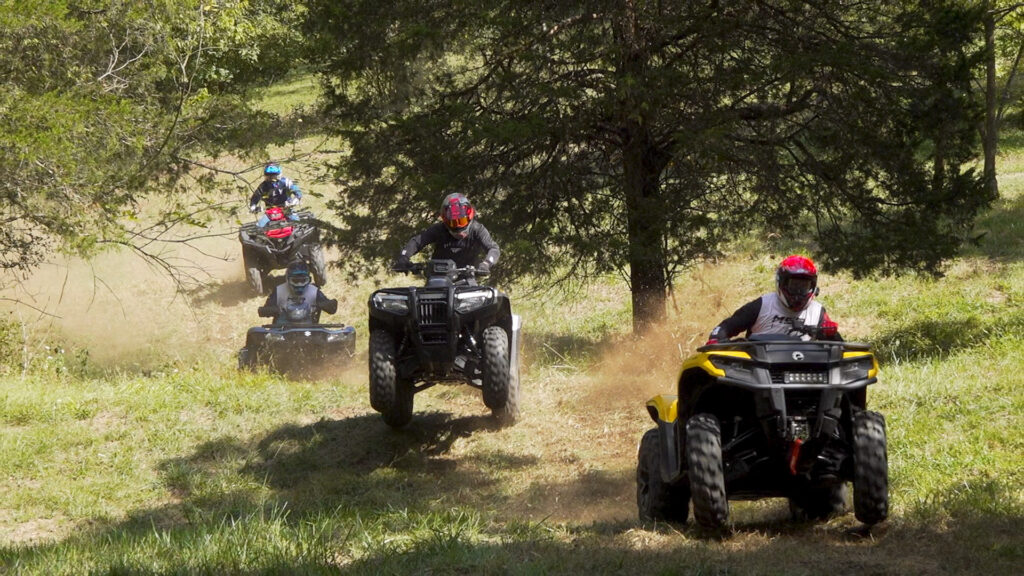
All of these ATVs feature disposable, non-rebuildable shocks whose performance degrades over time. Elka shocks are completely rebuildable and serviceable, so they can be maintained for the life of your ATV. Custom-built and offering various levels of adjustability, they can provide a plusher ride or more bottoming resistance on the trail along with enhanced work capability. Elka shocks are ideal for the job site, the trail, or the rigors of 4×4 cross-country racing. They’re available for all models in our shootout. Learn more at elkasuspension.com.
Electronic power steering is available and found on all of these ATVs except the Honda. The Can-Am features its Tri-Mode Dynamic Power Steering, offering three levels of assistance. The Suzuki and Yamaha feature single-mode power steering.
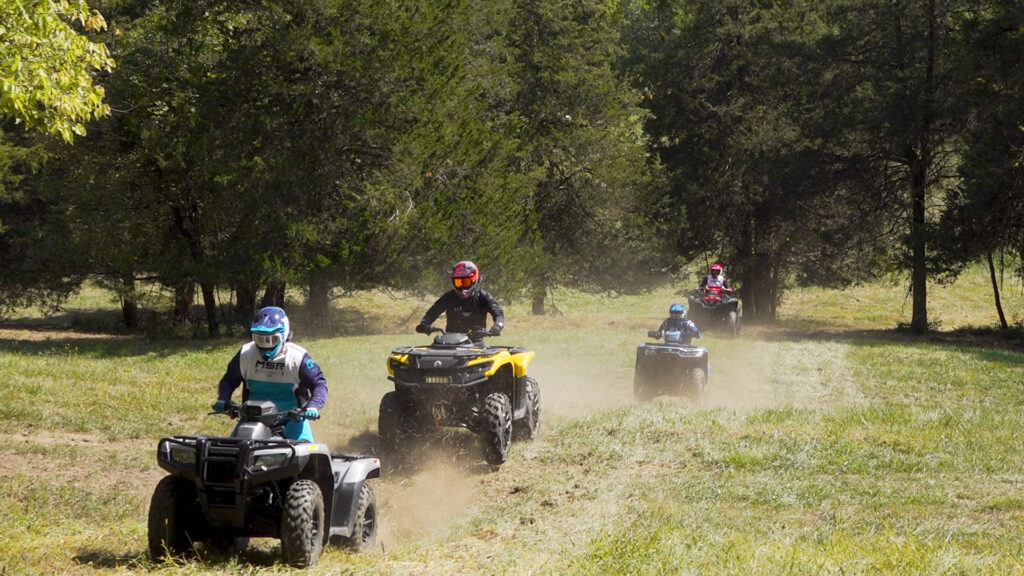
All four machines feature cast aluminum wheels. Three of them use 12-inch wheels, with the Can-Am using 14s. They’re wrapped in XPS Trail Force radial tires, 26x8x14 front and 26x10x14 rear. The Honda uses Maxxis radial tires, 26x8x12 front and 26x10x12 rear. The Yamaha features 26x8x12 front and 26x10x12 bias-ply Maxxis tires. The Suzuki utilizes 25x8x12 front and 25x10x12 rear Carlisle bias-ply tires.
We measured the actual widths of these ATVs tire edge to tire edge in the rear. Looking at the scale of these ATVs, the Outlander 700 is the biggest. It’s 47.75 in. wide with a wheelbase of 53 in., 12.5 in. of ground clearance, 38.6 in. seat height, and an overall length of 89.9 in., making it the largest in every way. Next in scale is the Suzuki KingQuad 750. It’s the narrowest at 46 in., has the second-longest wheelbase, tied with the Rubicon at 50.6 in., is third in ground clearance at 10.2 in., has the second-highest seat height at 36.2 in., nearly tied with Yamaha, and is the second-longest in overall length at 82.7 in. Third in scale is the Grizzly 700. Its 46.5 in. width is tied for second with the Rubicon. It has the shortest wheelbase at 49.2 in., the second-highest ground clearance at 11.3 in., the second-lowest seat height at 36.1 in., and the second-shortest overall length at 81.5 in. The Rubicon is the most compact. Its width ties with Yamaha for second at 46.5 in. Its wheelbase ties for second with the KingQuad at 50.6 in. It’s fourth in ground clearance at 9.5 in., has the lowest seat at 34.8 in., and has the shortest overall length at 81.1 in.
Chassis and Suspension Specifications
| Specification | Can-Am Outlander XT 700 | Honda FourTrax Rubicon 700 4×4 Automatic | Suzuki KingQuad 750AXi Power Steering SE | Yamaha Grizzly 700 EPS |
|---|---|---|---|---|
| Chassis / Frame | Steel chassis | Steel chassis | Steel chassis | Steel chassis |
| Front Suspension | Independent double A-arm | Independent dual A-arm | Independent dual A-arm | Independent dual A-arm |
| Rear Suspension | Independent double A-arm with anti-sway bar | Independent dual A-arm with anti-sway bar | Independent dual A-arm with anti-sway bar | Independent dual A-arm with anti-sway bar |
| Front Travel (double A-arm) | 9.75 in. | 6.9 in. | 6.9 in. | 7.6 in. |
| Rear Travel | 10.25 in. | 8.0 in. | 7.7 in. | 9.1 in. |
| Shock Adjustability | 5-way preload adjustable | Not adjustable | 5-way preload adjustable | 5-way preload adjustable |
| Rear Sway Bar | Yes | Yes | Yes | Yes |
| Power Steering | Tri-Mode Dynamic Power Steering | Not equipped | Electric power steering | Electric power steering |
| Skid Plate / Underbody Protection | Full skid plate; no A-arm protection noted | Under-frame plastic skid plates with driveshaft guards | Plastic skid plates on frame and A-arms | Plastic skid plates on frame and A-arms |
| Front / Rear Guards | Front and rear steel bumpers / guards | Steel front guard | No front guard noted | Tubular steel and composite front guard |
| Front Tires | XPS Trail Force Radials 26x8x14 | Maxxis radial 26x8x12 | Carlisle bias-ply 25x8x12 | Maxxis bias-ply 26x8x12 |
| Rear Tires | XPS Trail Force Radials 26x10x14 | Maxxis radial 26x10x12 | Carlisle bias-ply 25x10x12 | Maxxis bias-ply 26x10x12 |
| Wheels | 14 in. aluminum | 12 in. cast aluminum | 12 in. cast aluminum | 12 in. cast aluminum |
| Measured Rear Width | 47.75 in. | 46.5 in. | 46 in. | 46.5 in. |
| Wheelbase | 53 in. | 50.6 in. | 50.6 in. | 49.2 in. |
| Ground Clearance | 12.5 in. | 9.5 in. | 10.2 in. | 11.3 in. |
| Seat Height | 38.6 in. | 34.8 in. | 36.2 in. | 36.1 in. |
| Overall Length | 89.9 in. | 86.5 in. | 84.6 in. | 81.5 in. |
| Claimed Weight | 858 lb dry | 701 lb curb | 721 lb curb | 701 lb curb |
Braking Systems
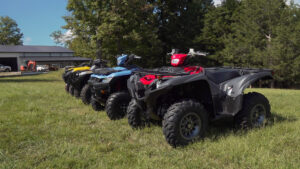
All three Japanese brands feature separate front and rear brakes operated with handlebar-mounted levers for each and a right-side-mounted foot pedal controlling the rear. The Can-Am features a single handlebar-mounted lever controlling braking for both ends with a separate foot pedal controlling the rear independently. All four machines feature dual hydraulic disc brakes up front. The Yamaha features dual hydraulic disc brakes mounted at the rear wheels. The Can-Am has a similar rear setup with a single disc. The Honda has a disc brake mounted on the rear driveshaft. The Suzuki features a sealed rear multi-disc system.
Braking Specifications
| Specification | Can-Am Outlander XT 700 | Honda FourTrax Rubicon 700 4×4 Automatic | Suzuki KingQuad 750AXi Power Steering SE | Yamaha Grizzly 700 EPS |
|---|---|---|---|---|
| Front Brakes | Dual hydraulic disc brakes | Dual hydraulic disc brakes | Dual hydraulic disc brakes | Dual hydraulic disc brakes |
| Rear Brakes | Single hydraulic disc brake | Rear driveshaft-mounted hydraulic disc brake | Sealed rear multi-disc brake system | Dual hydraulic disc brakes |
| Brake Controls | Single handlebar lever controls both ends, plus separate rear foot pedal | Separate front and rear brake controls via handlebar levers and foot pedal | Separate front and rear brake controls via handlebar levers and foot pedal | Separate front and rear brake controls via handlebar levers and foot pedal |
| Parking Brake | Yes | Yes | Yes | Yes |
Utility Capabilities
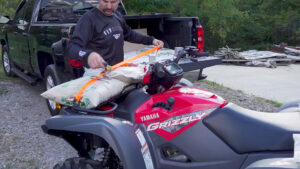
While all are marketed for work and play, not all of these machines appear as adept at getting the job done on paper. All feature front and rear cargo racks. The Yamaha and Honda use steel racks front and rear, as does the Suzuki. However, Suzuki covers theirs with removable smooth plastic covers. The Can-Am features steel racks surrounding a large cargo box up front and a large open cargo area in the rear, similar to a small bed on an SxS.
The Outlander is rated to haul the most at 360 lb., with 120 lb. front and 240 lb. rear. Second is the Yamaha Grizzly at 308 lb., with 110 lb. front and 198 lb. rear. Third is the Rubicon at 286 lb., 99 lb. front and 187 lb. rear. Fourth is the KingQuad at 284 lb., 99 lb. front and 185 lb. rear.
For on-board storage, the Can-Am has a sealed 9-gal. storage box in the front rack with a removable lid plus a sealed 1-gal. storage box between the rider’s knees with a USB port for power. The Honda features a small storage box located in the center of the front rack plus an additional 1.8L storage box built into the left side of the bodywork. The Suzuki features two 4L boxes at the rear with a 2.8L water-resistant box on the right front fender. The Grizzly features a nice-size storage box between the rider’s knees and another at the back of the machine. There’s also a sealed box under the round lid on the back of the right front fender.
Three of the machines in this shootout come with a 2-inch hitch receiver. The KingQuad 750 SE also includes the hitch from the factory. Surprisingly, the Honda doesn’t come with a hitch receiver or ball mount. You must add one as an accessory. Strange on a sport utility.
In towing ratings, the Outlander 700 is rated to tow 1,830 lb., KingQuad 750 1,322 lb., Grizzly 700 1,300 lb., and the Rubicon 700 848 lb., almost a half-ton less than the Outlander.
Utility Specifications
| Specification | Can-Am Outlander XT 700 | Honda FourTrax Rubicon 700 4×4 Automatic | Suzuki KingQuad 750AXi Power Steering SE | Yamaha Grizzly 700 EPS |
|---|---|---|---|---|
| Front Rack / Cargo Area | Steel rack surrounding sealed front storage box | Steel front rack | Steel front rack with removable plastic cover | Steel front rack |
| Rear Rack / Cargo Area | Steel rack surrounding open rear cargo area | Steel rear rack | Steel rear rack with removable plastic cover | Steel rear rack |
| Front Rack Capacity | 120 lb | 99 lb | 66 lb | 110 lb |
| Rear Rack Capacity | 240 lb | 187 lb | 132 lb | 198 lb |
| Total Rack Capacity | 360 lb | 286 lb | 198 lb | 308 lb |
| On-Board Storage | Sealed 9-gal. front storage box plus sealed 1-gal. center storage box with USB power | Small front-rack storage box plus 1.8L left-side bodywork storage box | Two 4L rear storage boxes plus 2.8L water-resistant right-front-fender storage box | Center storage box between rider’s knees, rear storage box, plus sealed right-front-fender storage box |
| Listed Storage Volume | 10 gal. total noted in shootout | Front storage volume not listed; 1.8L side storage listed | 10.8L total listed | Total volume not listed |
| Hitch / Receiver | 2 in. hitch receiver | No hitch receiver or ball mount included; accessory required | 2 in. hitch receiver. Hitch included on SE | 2 in. hitch receiver |
| Towing Capacity | 1,830 lb | 848 lb | 1,322 lb | 1,300 lb |
| Factory Winch | Yes, Can-Am HD3500 winch | No | No | No |
Riders and Location
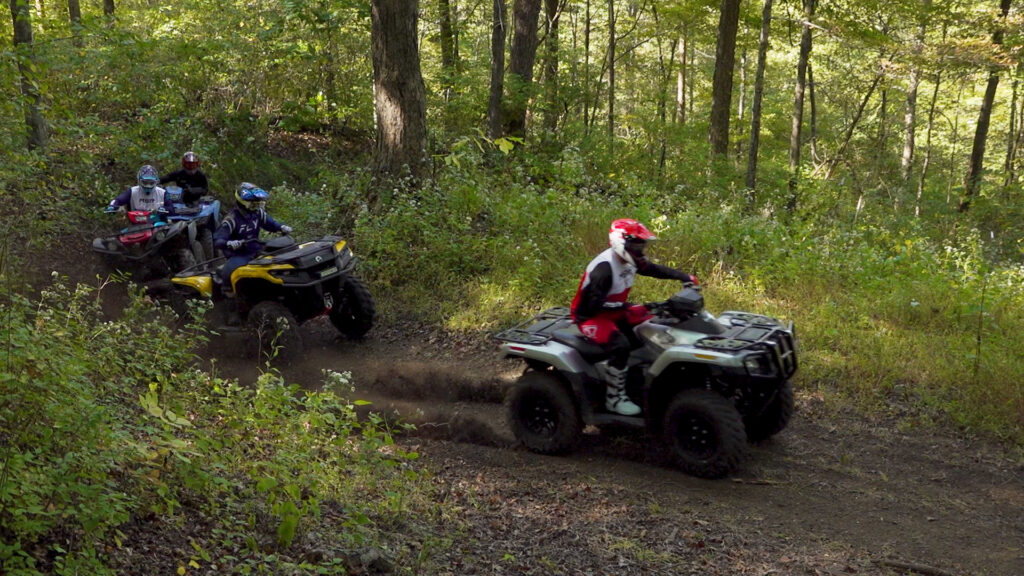
Testing for this shootout took place on a hilly private property in West Harrison, Indiana, featuring elevation changes, off-camber sections, and a mix of faster trail and technical terrain that highlights differences in power delivery, handling, and suspension performance.
Our rider panel includes a range of backgrounds to provide balanced, real-world feedback. Riders include former pro ATV MX racer Aaron Meyer, heavy equipment operator and long-time 4×4 ATV owner Casey Meyer, 450cc sport ATV XC racer Isaac Hart, and B-class 4×4 GNCC racer Landon Dean. Lastly, as a 30-year ATV rider and 20-year ATV journalist, after filming was done I rode and rated each of these machines myself to round out the rider pool.
Scoring and Testing
For this shootout, each ATV is rated by our riders on a 1-10 scale for Engine, Drivetrain, Suspension, Handling, Braking, Fit and Finish, and Utility Performance.
There is also 1 full bonus point available based on four special tests, with a quarter point awarded for each: Best Initial Value, Drag Race, Cross-Country Race, and Best Utility.
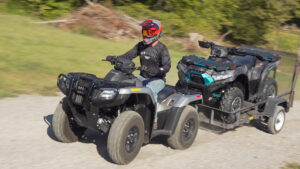
For utility testing, we compare the volume of each machine’s on-board storage. With the largest capacity, we stuffed the Can-Am’s storage boxes with all they could handle, followed by the others, to see what was left over with each. Next, we maxed the shocks’ preload settings and loaded the racks with 100 lb. front and 150 pounds rear and took each machine for a ride on a combination of flat to very hilly terrain. Finally, we left the rear shocks’ preload maxed, fully softened the front, and hooked up a trailer hauling a Kawasaki Brute Force 750 EPS loaded toward the front of the trailer to max the trailer’s tongue weight. Total weight for both was around 1000 lbs. Each machine towed the trailer down and up a long, steep, twisty gravel driveway to test its towing capabilities.
As the most skilled rider in our shootout, former Pro MX ATV Racer Aaron Meyer was chosen to ride each machine for the roughly 2.2-mile Cross-Country Race and roughly 75-yard uphill Drag Race. He performed each race on each machine to the best of his ability, and then we placed all four runs side by side to determine how they performed.
Each ATV will be presented in the order in which it finished in the shootout, making it easier to better understand each machine’s overall performance. Based on the information presented in this shootout, we strongly recommend buying the ATV that best suits your personal needs instead of simply buying based on who wins, unless it’s the right ATV for you.
Scoring and Testing Format
| Scoring Area | How It Was Tested / Scored |
|---|---|
| Engine | Riders scored low-end power, midrange power, top-end power, transmission effectiveness, engine braking, and overall rideability. |
| Drivetrain | Riders scored four-wheel-drive engagement and four-wheel-drive effectiveness. |
| Suspension | Riders scored small bumps, large bumps, uneven bumps, whoops, and adjustability. |
| Handling | Riders scored steering precision, power steering, cornering stability, side-hill stability, high-speed stability, weight feel and balance, and ground clearance. |
| Brakes | Riders scored front brake performance and rear brake performance. |
| Fit and Finish | Riders scored ergonomics, control operation, and lack of vibration. |
| Utility Performance | Riders scored onboard storage, engine hauling/towing, suspension hauling, handling while hauling, suspension towing, and handling while towing. |
| Drag Race Bonus | Each ATV was run in a roughly 75-yard uphill drag race. Winner received a 0.25-point bonus. |
| Cross-Country Race Bonus | Each ATV was run on a roughly 2.2-mile cross-country loop by the same rider. Winner received a 0.25-point bonus. |
| Best Utility Bonus | Utility testing included onboard storage comparison, loaded rack testing, and towing a trailer carrying a Kawasaki Brute Force 750 EPS. Winner received a 0.25-point bonus. |
| Best Initial Value Bonus | Features, performance, equipment, and MSRP were compared. Winner received a 0.25-point bonus. |
| Final Score | Rider ratings were combined with earned bonus points. |
The Shootout
Honda Rubicon 700
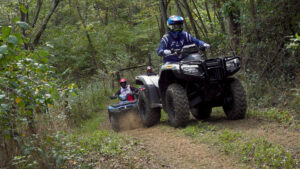
The Honda was a consistent starter and runs clean. With the lowest power-to-weight ratio combined with a torque-converter-assisted three-speed transmission, which is not super efficient at harnessing power, the Honda Rubicon 700 has one of the slowest-revving and undoubtedly mellowest engines of the bunch.
Low-end power is where the engine pulls hardest, making getting rolling and climbs easier. Power keeps building through the midrange but gets mellower throughout the midrange and top end.
We found the automatic shifting to do a pretty good job of choosing the right gear, rarely forcing us to override auto unless we simply wanted more RPMs. Engine braking was variable depending on gear selection, which we liked. Unfortunately, notably less power and too few gears to harness it resulted in the Rubicon scoring at the bottom in every aspect of engine performance.
The TraxLok four-wheel-drive system is simple to engage, although the switch seems a little outdated compared to others. Effectiveness is more of an issue. While it does better at finding grip than a limited-slip front differential, transferring power to whichever front tire is getting grip combines with a lack of power steering, resulting in a front end that wants to wander more than we’d like, especially when switching between the Honda and the three other ATVs with power steering. This resulted in the Rubicon taking fourth in drivetrain performance.
Suspension action is plush over smaller bumps at low to intermediate speeds. When you ride at a quicker pace, the suspension starts feeling a little harsher over roots and rocks. Big hits from abrupt g-outs, deep water-rut crossings, or jump landings result in a harsh bottoming when riding aggressively. The harsher ride makes the Honda rate lower in uneven bumps when you’re trying to carry speed. The willingness to bottom easily made our riders most apprehensive about riding the Rubicon in whooped-out terrain. Obviously, with zero adjustability, we couldn’t tune ride quality, and there’s no score for suspension adjustability. Our riders felt the suspension fell behind the competition in every aspect of performance.
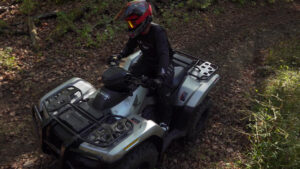
In handling, the Honda is plagued by its lack of power steering. First, more than many other non-EPS models, the Honda’s front end wants to follow the direction of whichever front tire is getting the most traction. This tendency is magnified noticeably when the TraxLok 4WD is engaged. This hurts steering accuracy. On top of that, power steering is a category in this shootout, so we judged the Honda on its ease of steering, bump feedback, and ability to hold a line, as we did the others. The Rubicon falls behind in those aspects, also causing a deficit in steering accuracy. The Honda’s decent width and the lowest seat height build confidence in turns until speeds rise, where its wandering front end shows up, making the Rubicon feel less stable than the others in corners. However, on steep off-cambers the Honda feels predictably planted compared to the narrower, taller KingQuad. In high-speed stability, again, the lack of power steering makes the Rubicon feel less predictable the harder you ride, making it feel the least stable at high speeds. In spite of tying for the lightest machine in the shootout with the Yamaha, the lack of power steering makes it feel like the heaviest. In spite of the Honda having the lowest ground clearance on paper, it ties the Suzuki for second in ground-clearance rider ratings. We assume this is due to more low-speed compression damping in the shocks combined with less horsepower compressing the suspension.
Braking performance tightens up, and it’s no surprise to see the Honda doing better here. The Rubicon’s front brakes offer good power and feel, lacking just a bit in the power department compared to the others. Despite its perfectly placed rear brake pedal, the rear brake falls farther behind, taking a bit more power to actuate and not being as easy to modulate, sometimes resulting in a little unwanted skidding on loose descents. Landon tied the Honda’s brakes for third with the Can-Am. Casey rated it third, ahead of the Suzuki. In the end, the Honda found itself fourth in braking.
When it comes to fit and finish, the Rubicon’s ergonomics are going to appeal to a lot of riders, especially those who value a lower seat height for getting on and off or enhanced control over the machine. Also, the raised steel footpegs are among the best in class, offering plenty of room to pivot your foot or allow room for mud or snow buildup. For these reasons, the Honda outshined the Suzuki in ergonomics. Control operation on the Rubicon was good, but things felt a bit more dated in the Honda’s cockpit, still edging out the KingQuad in control operation. Our riders felt the Honda transferred a bit more thump from the engine to the handlebars, giving it fourth in lack of vibration. Together, the Honda took fourth in fit and finish.
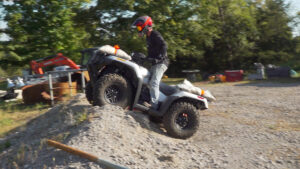
Utility performance is good for a machine that doesn’t come with a hitch receiver or ball mount stock, although on-board storage is the most limited of the bunch. We love steel racks, with rack ease of loading tying for second with two of the others. The engine did fine at hauling and towing, but its over-20% horsepower deficit is noticeable compared to the others when working. Hauling, its suspension ties for second in spite of its lack of adjustability thanks to the shocks’ seemingly higher amount of low-speed damping keeping the ride from feeling boaty. The shocks’ good load-carrying control and overall stable footprint allow the Rubicon to tie for first in handling while hauling. Even with no shock preload to balance the ride, the Honda takes second in towing for suspension and handling. More storage, power, and spring preload would have helped, but the Honda still takes a strong third in utility performance.
In the other special tests, the Honda got gapped in the drag race due to its lack of power and large gaps in the three-speed transmission. With a time of 15.17 seconds, it’s 1.71 seconds down from first. In our cross-country race, the power and transmission limitations were an issue. Add in the lack of power steering and suspension that had Aaron backing off a bit at times to keep from brutally bottoming both ends, and the Honda took a distant fourth in our cross-country race with a lap time of 4:25.25, 18.71 seconds slower than the fastest machine. With a price tag of $9,999, within $400 of the Yamaha and Can-Am, and its serious lack of features and horsepower, the Honda needs a $2,500 price drop or serious update to be considered for Best Initial Value.
With a fourth place in rider ratings and no additional score for special tests, the Honda Rubicon 700 takes fourth place with a score of 6.13 points.
Suzuki KingQuad 750
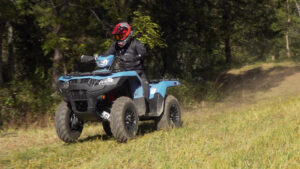
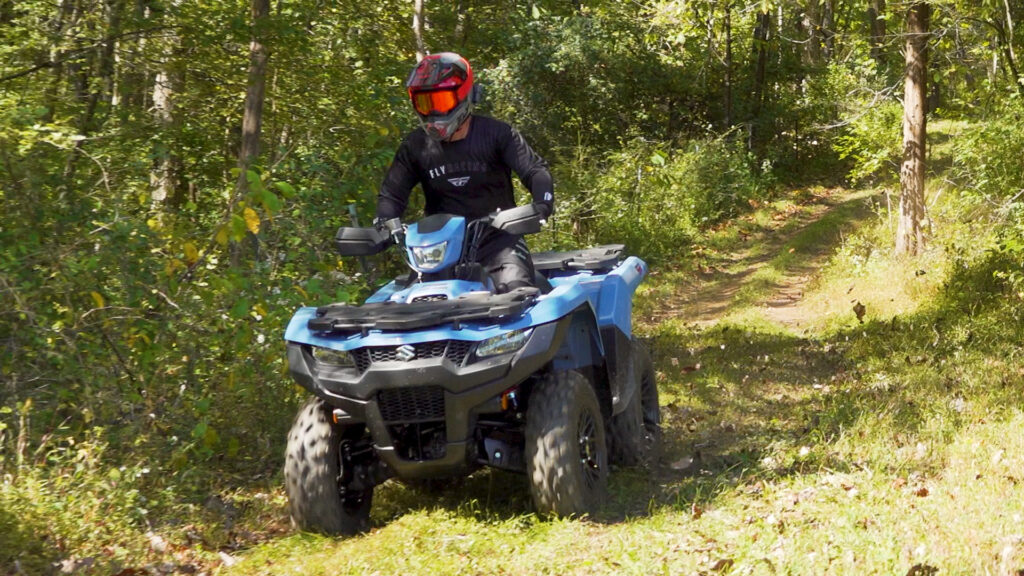
The KingQuad 750 fires up quickly and consistently. Its engine runs like the stroker of the group, scoring first in low-end power. Power comes on strong immediately off idle. This makes getting rolling quick with no need to build RPMs. Its low-end-focused engine and long-stroke feel make midrange and top-end power feel less impressive, scoring third in both. The centrifugal primary clutch offers super-smooth CVT engagement off idle, and the transmission does a good job of backshifting when you get off and back on the gas, keeping the engine in the meat of the power. While the transmission’s effectiveness is pretty flawless, it scored second behind the two machines that tied for first. The same holds true for engine braking, which might have just a touch more power than our riders preferred for spirited trail riding. The KingQuad was only .4 of a point behind in both. In overall engine performance, I tied it for first with the Yamaha. Casey rated it second. Landon, Isaac, and Aaron rated it third. With a two-way tie for first for overall engine performance, the KingQuad takes a respectable second.
The Suzuki features the drivetrain configuration most riders prefer. 2WD is there for getting drifty in loose or slippery conditions, although the narrower stance and high-torque engine make it less of a slider than others. Add in limited-slip 4WD and the KingQuad can conquer most situations while exhibiting its best handling manners. Front differential lock is there for snowy or muddy conditions, but steering is quite stiff in dry conditions, an issue for rock crawling. Drivetrain controls are simple and well refined. Four-wheel-drive engagement and effectiveness should be on par with the identically configured Yamaha, but less power steering assistance on the Suzuki makes control considerably more difficult with the front differential locked, affecting drivetrain results. Casey and Isaac have the KingQuad’s drivetrain in a three-way tie for first. Aaron tied it for second. Landon and I rated it alone in second. The Suzuki stands alone in second place for four-wheel-drive engagement and effectiveness by .4 of a point, taking a close second to the Grizzly in drivetrain performance.
With the narrowest stance, overcoming a lack of caster in the front end, and having the least amount of travel, Suzuki had to make some compromises when it comes to suspension action, but they made the most of it. Partly shocks and partly smaller 25-inch tires, the Suzuki feels firmer over smaller bumps at low or higher speeds. It’s not punishing, just firmer. On the flip side, the Suzuki never bottomed under any of our riders, even hitting abrupt water ruts, so we could never fully utilize the available suspension travel. Again, it wasn’t overly harsh. In uneven bumps, you are going to give up some independent action with firmer shock settings. The smaller rollover of the tires adds to a firmer-feeling ride in chunky uneven terrain. For whoops, the firm shocks and mid-length wheelbase make the KingQuad capable. While the shocks are preload adjustable, they’re firm enough that you can’t simply make them feel plush by reducing the preload two notches, which keeps it from rating higher in adjustability. The Suzuki took third in every aspect of suspension performance. Landon rated it second overall. The rest of us rated it third, with the KingQuad 750 taking third in suspension.
For handling, when it comes to steering precision, the Suzuki goes where it’s pointed, but heavier power steering at low to mid speeds, with more bump feedback through the steering than the other power-steering-equipped machines, put the Suzuki in third for both steering accuracy and power steering. Twenty-five-inch tires plus other design attributes help lower the KingQuad’s center of gravity. Add in stiffer suspension settings and the Suzuki scores a third in cornering stability despite having the narrowest width and middle-of-the-class seat height. In spite of having decent manners on side hills, there’s no hiding the narrower width when it comes to side-hill stability, where the KingQuad takes fourth. When the trail opens up, the Suzuki’s mid-length wheelbase, firm suspension, and power steering that works best at higher speeds are counteracted by a lack of front-end caster, giving the KingQuad a third in high-speed stability. The Suzuki also takes third in weight feel and balance with its heavier-feeling power steering and narrower chassis. With a two-way tie for first in ground clearance, the Suzuki ties with Honda for second. Every rider rated the Suzuki’s handling third, giving the KingQuad 750 a third-place finish in handling.
The Suzuki’s brakes are adequate for whatever you throw at it. The front brakes offer good power and feel, tying for second. The sealed multi-plate rear brake offers decent power but lacks the feel of some of the other standard rear disc setups, taking third in rear brakes. Aaron doesn’t need brakes, so he tied all of them. Isaac and Landon rated the brakes second. I rated them third, and Casey rated them fourth. Overall, the Suzuki’s brakes score third.
The Suzuki only drew a few complaints when it came to fit and finish. One was the bulge on the right side of the engine partially blocking the rear brake pedal. Some riders also weren’t fans of the taller handlebars. The T-shaped seat still draws praise, as do its raised steel footpegs offering plenty of room for pivoting and mud or snow buildup. It’s certainly not uncomfortable, but it takes fourth in ergonomics, just .2 of a point behind the third-place Honda. While there were no glaring issues with control operation, our riders collectively rated them fourth. Again, only .2 of a point behind the Honda. In spite of pulling like the stroker of the group, it scores third in lack of vibration. Aaron rated the Suzuki’s fit and finish first. Landon rated it second. Casey and Isaac rated it fourth. I tied it for third with the Honda. In the end, the Suzuki edges out the Honda for third in fit and finish.
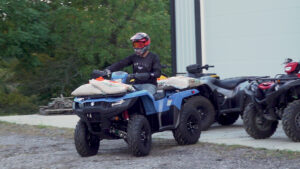
The Suzuki comes into utility testing with a third place in overall rider ratings. In on-board storage, the KingQuad takes a respectable third. From there, it runs the table. With full steel racks with removable plastic covers, the KingQuad takes first in rack ease of loading. Its class-leading low-end power gets loads moving more easily than any other machine in the shootout, taking first in engine hauling and towing. Stiffer suspension that ranks a respectable third on the trail controls a heavy load better than the others. In spite of its narrower width, the Suzuki ties the Honda for first in handling while hauling. Stiff suspension and the middle-of-the-road wheelbase offer ample leverage over a heavy trailer tongue weight, maintaining steering accuracy, with the KingQuad taking first in suspension towing and handling towing. The Suzuki scores highest in utility performance. Plus, it takes an additional 1/4 point for winning Best Utility.
The Suzuki produced a drag race time of 13.67 seconds, .21 seconds slower than the fastest machine, tying for second thanks to its immediately available low-end power and strong torque. It was surprising to see how competitive the KingQuad was in the Cross-Country Race. We feel its surprising performance was due to its immediately available, strong low-end power powering out of corners. Stiff suspension kept Aaron from backing off at all on abrupt water-rut crossings, maintaining momentum. Its stiff shocks also help keep the quad riding level in turns and manageable on side hills, complemented by its smaller 25-inch tires helping lower the center of gravity while enhancing acceleration. All add up, making the KingQuad deceptively fast. In the cross-country lap times, the Suzuki turned a lap time of 4:12.13 seconds, 5.59 seconds slower than first, edging out third place by .25 seconds. The margin between it and third could have come down to one minor difference in rider performance, but still, it managed to land on the second box on the podium in the Cross-Country Race. When it comes to initial value, the Suzuki delivers on quality of construction, but it’s pricey. At $11,729, it’s $1,330 more expensive than the equally appointed Grizzly and $1,480 more expensive than the Outlander 700 XT.
In final scoring, the Suzuki takes third in rider ratings with a score of 7.59 points, plus a .25-point bonus for winning Best Utility. With a final score of 7.84 points, the Suzuki KingQuad 750 is a respectable performer, taking third overall in the shootout.
Yamaha Grizzly 700
The Grizzly was a consistent starter hot or cold. The Grizzly has a solid midrange motor, never feeling weak in any part of the RPM range. It also builds RPMs at a good pace, adding to the engine’s fun factor. Low-end power is good, scoring second, working well at getting the Grizzly moving or tackling tight sections of trail. Midrange power is class leading, making the Grizzly fun to power out of turns or up long hills. Top-end power keeps pulling when the trail opens up, taking second in top-end power.
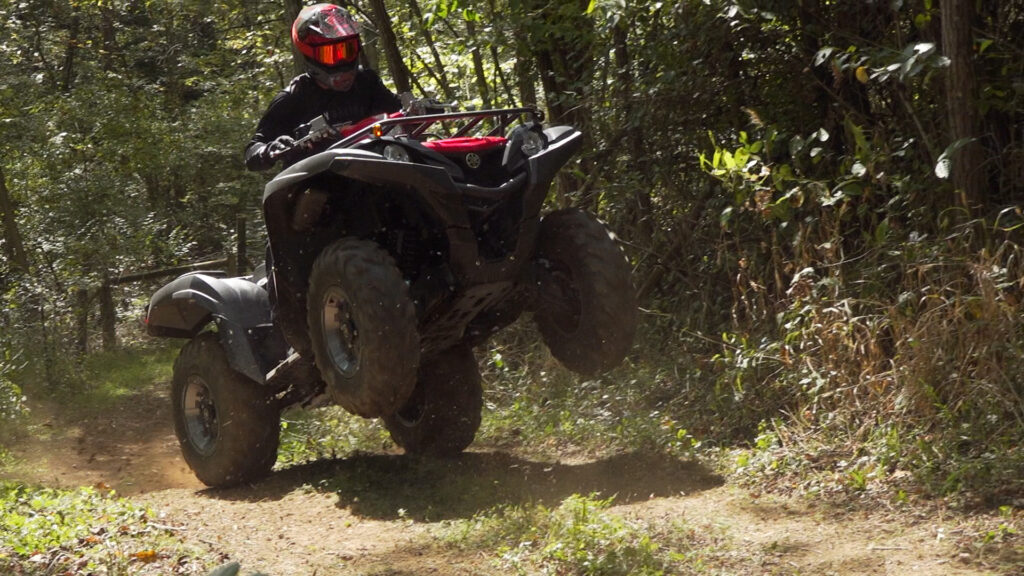
Off-idle CVT engagement couldn’t be smoother, thanks to the centrifugal clutch. Never laggy getting off and back on the gas, Yamaha ties for first in transmission effectiveness. It also ties for first when it comes to engine braking, with a smooth transition into deceleration when you let off the gas and well-balanced braking effect for technical and sporty riding. With good power, perfect power distribution, and an excellent transmission, the Yamaha’s engine takes first in overall rideability. Landon rated the Yamaha’s engine first, Casey and I tied it for first, Isaac and Aaron rated it second, with the Grizzly’s engine performance tying for first place.
The drivetrain configuration is what most riders prefer. With 2WD on tap for slides, the Grizzly is a capable slider, but we left the drivetrain in limited-slip 4WD for 90% of our testing to maximize steering accuracy. Switching from 2WD to 4WD happens on the fly. Come to a stop and the front differential locks in or unlocks with little hassle, just a little wiggle of the handlebars sometimes. The controls to engage and disengage the different drive modes work beautifully. The Grizzly takes first in drivetrain engagement and effectiveness. Some of this might have had to do with the updated EPS making diff lock a joy to use in dry and wet conditions alike. All of our riders rated drivetrain performance first, with Casey and Isaac tying it for first with two other models, giving the Grizzly first in drivetrain performance.
The Grizzly’s suspension is very well rounded. It does well damping small hits at all speeds, scoring second in small bumps. It eats up jumps, g-outs, and abrupt water ruts, which sometimes bottomed the front shocks but never harshly, scoring second for large bumps. It’s good at conforming to uneven bumps on the trail, again taking second. Good suspension and the machine’s light weight let it score second for use in whooped-out terrain. Well-calibrated shocks with five-way preload adjustability let the Grizzly score second in suspension adjustability, taking second in every aspect of suspension performance. All of the riders rated the Yamaha’s suspension second except Landon, who rated it first. In the end, the Grizzly’s suspension performance takes second.
Light, stable, and precise handling tie in well with the Yamaha’s sporty engine and suspension. Steering precision is class leading due in part to its recently revised, class-leading power steering. It edges out second place in both categories. It goes where it’s pointed with either end steering. The power steering keeps steering light and makes unwanted feedback a non-issue. The Yamaha feels predictably planted in turns. There is a small amount of front-end dive on off-camber downhills, but nothing worrisome. Side-hill stability is also good, but very mild front-end roll was also noticeable there. Perhaps the weight transfer adds to steering precision, but it results in the Grizzly taking second in cornering and side-hill stability. The shorter wheelbase and increased power steering assist could have resulted in the Grizzly feeling nervous at speed, but it remains the second-most-stable machine in high-speed stability. Weight feel and balance are amazing. Wheelies, changing direction, no problem. The Grizzly is the lightest, most agile-feeling ATV in the shootout, winning in weight feel and balance. While down a little in ground clearance compared to the Can-Am, its more compact wheelbase resulted in it tying for first in ground-clearance ratings. Overall, Casey tied the Grizzly’s handling for first, I rated it first, and Landon, Isaac, and Aaron rated the Grizzly’s handling second, resulting in the Grizzly taking second in handling by .2 of a point.
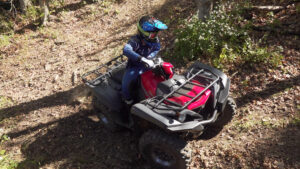
The Grizzly’s sporty brakes are strong at both ends, offering good feel and easy modulation. They take first front and rear. Landon, Casey, and I rated the Yamaha’s brakes first, Aaron tied it for first, and Isaac rated it third. Overall, the Grizzly comes to a halt in first for brakes.
For fit and finish, the Grizzly’s ergonomics are narrower than some between the rider’s knees. While steel pegs are a nice touch, they’re narrow and don’t offer much height over the floorboards for pivoting your foot or for mud or snow buildup. The biggest hindrance is the seat that’s held on by rubber grommets. We had issues with it falling off during aggressive riding. Yamaha needs to fix this. Still, it scored second in ergonomics. Control operation was the best in the shootout overall. Its lack of vibration was second. Landon and Casey rated the Yamaha highest in fit and finish, Isaac and I rated it second, and Aaron rated it third. Overall, the Grizzly takes first in fit and finish by .03 of a point.
Heading into utility testing, the Grizzly was in first place in rider ratings for the trail by .08 of a point. In utility performance, the Grizzly scored second in on-board storage. Its steel racks tie with two other contestants for second in rack ease of loading. With good low-end power, the Grizzly ties for second in engine hauling and towing. The compact wheelbase and plush suspension that add to its light feeling on the trail hold it back a bit in hauling and towing. Even at max preload, the shocks feel wallowy and the ride feels boaty in all directions. It’s still pretty planted, but that doesn’t keep it from taking last in suspension hauling and handling while hauling. When towing, even with the front shocks set to full soft, the Grizzly’s front end wanted to push more than the others, resulting in a last-place finish in suspension towing and handling towing. We know from experience that the Grizzly is a capable worker, but its performance skews harder toward sporty recreational riding, taking last in utility performance.
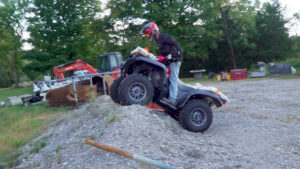
Without winning Best Utility, heading into the other special test categories the Yamaha lined up on the hill for the drag race, putting in a time of 13.67 seconds, .21 seconds behind first, surprising considering its class-leading power-to-weight ratio. We suspect the centrifugal clutch takes a hair longer to initially engage and it doesn’t rev quite as fast as the first-place finisher, tying with the KingQuad for second. For the cross-country race, the Yamaha’s light handling, good stability, and capable engine make it feel quick. However, with a little more body roll than others and seemingly the second-fastest-revving engine, the Yamaha battled for second. It put in a lap time of 4:12.38. Shockingly, this was third fastest, in a virtual tie with Suzuki, which put in a time of 4:12.13, a .25-second difference. This could have come down to minor line choice out on the trail. The Grizzly was 5.84 seconds down from first place. We suspect 25-inch tires would have been all that was required for the Yamaha to battle for the win. The Grizzly is high on our list for initial value, but a slightly higher price with a few fewer parts kept the Yamaha from winning Best Initial Value.
In overall scoring, based on rider ratings for trail performance alone, the Yamaha Grizzly scores highest by a very close .08 of a point. Average in utility performance, and the Grizzly falls to second in rider ratings. Without winning any of the special test categories, the Grizzly’s strong trail performance still nets it a second-place finish at 8.08 points.
Can-Am Outlander 700 XT
The Outlander 700 is a bit of a slow starter. The engine turns over more slowly than the rest, taking more time to fire up when the engine is hot. Low-end power isn’t especially weak, but it’s not as strong as the Suzuki or Yamaha, taking third in low-end. Midrange power continues building, becoming notably more impressive in the upper midrange where the engine starts to really come alive, taking second in midrange power behind the Grizzly. The upper-midrange and top-end rush are almost sport-ATV-like, feeling as though the engine is pulling harder than any other in the shootout with some arm-stretching authority, scoring first in top-end power. The pDrive-clutch-equipped transmission accelerates out of the hole with a little more snap than the others. This gives the heavier Can-Am the kick needed to get things moving quickly. From there, with demand from the throttle, the CVT lets the engine reach its impressive peak power with some urgency, making the most of its top-end rush. It ties for first in transmission effectiveness with the Yamaha. Engine braking comes on smoothly and provides well-balanced engine braking for general trail riding and working. Again, tying with the Grizzly for first in engine braking. While the engine is pretty flawless, the more top-end-focused power holds it back just enough to land second in overall rideability. Aaron and Isaac rated the Can-Am’s engine performance first. Casey tied it for first. Landon and I rated it second. In the end, the Outlander 700 ties the Yamaha for first in engine performance.
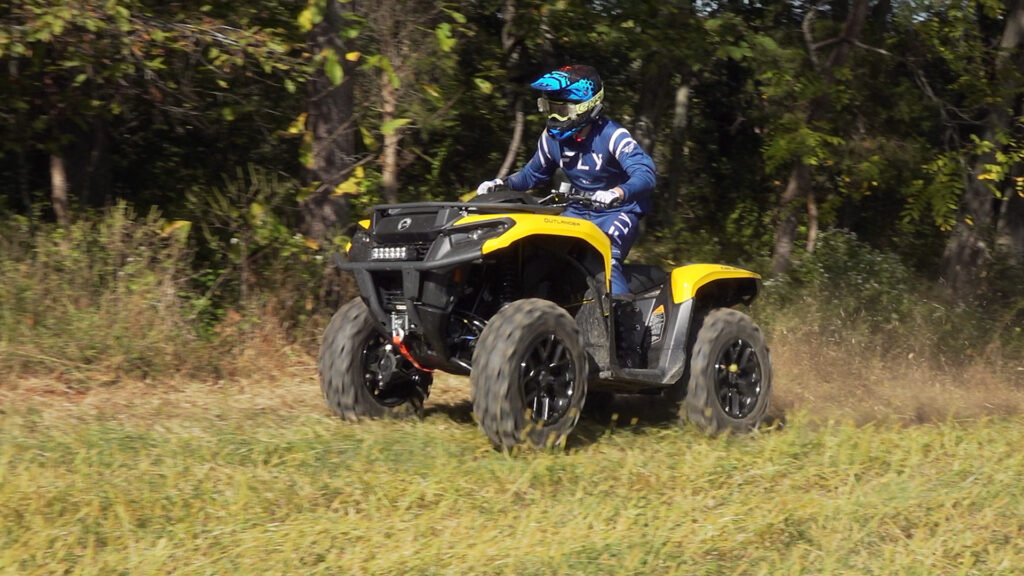
Drivetrain performance is the best among the smart, traction-sensing front differentials. 2WD is on tap for sliding around, which it does well. Four-wheel drive’s single-mode Visco-Lok QE auto-locking front differential progressively locks in both front wheels when one front tire breaks traction. It works well, but the switch is easy to hit during rough riding, sometimes knocking it out of 4WD. Also, when the Visco-Lok locks in both front wheels, we noticed a subtle clunking sound. It might not be serious, but it was enough to raise some concern among our riders, although any loss in grip was mostly undetectable in our high-traction testing conditions. Overall, the Can-Am scored third in four-wheel-drive engagement and four-wheel-drive effectiveness. Casey and Isaac tied it for first with the Yamaha and Suzuki. Aaron tied it for second with the Suzuki. Landon and I rated the Can-Am third, giving the Outlander 700 a third-place finish in drivetrain performance despite working quite well.
Can-Am’s known for outstanding suspension performance, and it lives up to that reputation on the Outlander 700 XT, running the table on the competition. Its suspension is the plushest over small bumps regardless of speed. It’s the only ATV in the shootout to bottom both ends on the most abrupt water ruts and g-outs, utilizing full travel but never bottoming harshly. It has the most travel in the shootout, and it feels that way on the trail. Its plush ride, the largest footprint, and 26-inch tires make it feel like the king of crawling in uneven terrain. The longest wheelbase and long-travel, well-rounded suspension made it the top pick for conquering whoops, although it lacks the light, floatable front end of the Grizzly. The shocks and ride leave room to soften things up or stiffen the ride to suit your needs. The Can-Am stands alone in first in every metric of suspension performance. Landon rated it second, .2 of a point behind the Grizzly. The rest of us rated the Can-Am’s suspension first, providing the Outlander 700 with a decisive win in suspension performance.
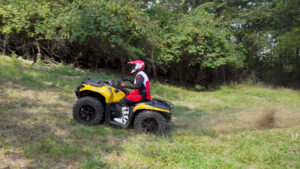
With class-leading suspension and the largest footprint, you’d expect the Outlander to be a great-handling ATV. Steering accuracy is quite good. However, less body roll and weight transfer seemed to be enough for it to score second in steering accuracy, .4 of a point behind the Grizzly. Can-Am’s Tri-Mode power steering is very good, with varying levels of assistance and good bump-feedback filtration, but our riders preferred the Grizzly’s power steering, if only by a mere .2 of a point. The Outlander is the most planted machine of the bunch in cornering stability and side-hill stability thanks to being the widest machine on test with very little body roll. Its length, width, outstanding suspension, and very good power steering make it the most stable-feeling machine at high speed. It takes first in all aspects of stability. Despite being the pig of the shootout on the scale, the Outlander takes second in weight feel and balance thanks again to its dimensions, suspension, and light power steering. Despite having a bit more ground clearance, suspension that’s willing to utilize all its travel when needed, along with the longest, widest footprint on test, the Can-Am ties the Yamaha for first in ground-clearance ratings. Casey tied the Outlander’s handling for first with the Grizzly. Landon, Isaac, and Aaron rated it first. I rated it second behind the Yamaha. In the end, the Can-Am beats the Yamaha by a tiny .2 of a point in handling.
Braking was a mixed bag with strong results. The single-lever braking has notable front-end bias, requiring you to utilize the rear brake pedal to balance braking front to rear. The rear pedal is a bit high, though. Separate brakes with an additional rear rotor and caliper like the 1000 might have been enough for it to take the win. Aaron tied all of the brakes with stopping as a second thought. Isaac rated the Outlander’s brakes first. Casey and I rated them second. Landon tied them for last with the Honda. In the end, the Outlander’s brakes took second behind the Grizzly.
Ergonomics are overall very good, but the Outlander definitely feels on the larger side. There’s plenty of room sitting or standing. The midsection is slim with smooth side panels, making gripping with your legs and moving around easy. The seat is plush, the handlebars are lower with a well-balanced sweep. The pegs are plastic, but wide and tall enough for pivoting or some debris buildup. Ergonomics take first, edging out the Yamaha. The four-wheel-drive switch, tall rear brake pedal, and need to use it leave the Can-Am taking second in control operation, swapping places with the Yamaha. Can-Am’s Rotax engine was the smoothest runner of the bunch, taking first in lack of vibration, a small .2 of a point ahead of Yamaha. Isaac and I rated the Can-Am’s fit and finish first. Aaron and Casey rated it second. Landon rated it third. In total, the Can-Am edges out the Yamaha in fit and finish by .2 of a point.
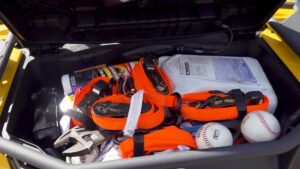
Trailing the Yamaha by .08 of a point heading into utility testing, the Can-Am takes the lead early in utility ratings, taking first in on-board storage. Its perimeter steel racks with front trunk and rear cargo bed are unique. The setup will work better for some loads, not as well for others. In the end, it tied for second in rack ease of loading with the others, with the KingQuad taking first. While not the most powerful down low, adequate torque, the pDrive-clutch-equipped transmission, and good gearing out of the hole, especially in low range, allow the Outlander’s engine to tie for second in engine hauling and towing with the Grizzly. Softer suspension makes the Outlander feel a little boaty with the racks loaded down. Fortunately, its large footprint offsets this somewhat. It ties for second in suspension hauling with the Honda and stands alone in second in handling while hauling. Again, the plusher suspension hurts it a bit in towing. With the longest wheelbase, though, it manages to hold on for third in suspension towing and handling towing. In the end, it takes second in utility performance, positioning it second in total rider ratings.
In second with no win for Best Utility, the Can-Am obviously has some much-needed special-test wins coming its way based on the others. First, it wins the Drag Race. With the most power on tap and the third-best power-to-weight ratio, the pDrive-equipped CVT offered some snap out of the hole. It allowed the engine to rapidly reach its potent top end with the fastest-revving engine of the bunch. It was enough to overcome its power-to-weight deficit, beating the Suzuki and Yamaha by .21 of a second and smoking the Honda by 1.71 seconds with a time of 13.46 seconds. In the Cross-Country Race, having the fastest acceleration, best overall suspension, and most stable handling let the Can-Am finish in 4:06.54, 5.59 seconds ahead of the Suzuki, 5.84 seconds ahead of the Yamaha, and a crushing 18.71 seconds faster than the Honda. The Can-Am wins the Cross-Country Race. Aside from its numerous class-leading specifications, its included winch and steel front and rear bumpers come along with a retail price of $10,249, allowing Can-Am to edge out the Yamaha for Best Initial Value. The Honda and Suzuki are simply a bit out of line when it comes to price.
Totaling the score, the Can-Am takes first in rider ratings at 8.14 points. Add in .25 point each for the Drag Race, Cross-Country Race, and Best Initial Value, and the Can-Am Outlander 700 XT wins the shootout with a total score of 8.89 points.
Conclusion
There’s a lot to take in from this shootout, but it seems there are a few main takeaways. When it came to trail performance according to the riders, the Yamaha barely edged out the Can-Am. The Yamaha is the top choice for riders who prefer light, agile handling. With a few minor setup tweaks, smaller 25-inch tires, and a set of Elka shocks to reduce body roll, it could easily be the fastest of the bunch on the trail. Despite feeling notably heavier and less agile, the Can-Am’s fast-revving top-end power, class-leading suspension, and stability made it fun and the fastest on the trail. The Yamaha and Can-Am would be our top choices for trail riding or cross-country racing. Both are capable workers despite not topping the list for utility.
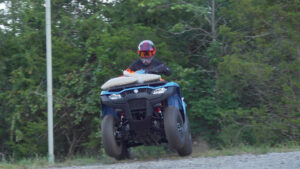
The KingQuad was the sleeper of the shootout. All of our riders commented on how the Suzuki exceeded their initial expectations on the trail, despite rating it third in trail ratings. Dominating in utility performance, it’s the hardest worker, in our opinion, and still very competitive in trail speed, edging out the Yamaha. With the shortest suspension travel and narrowest stance, though, its hop-up potential for sporty riding or racing is limited. If you prioritize work, it was the winner. If you still want to have fun, the Suzuki can do that too. It’s a little pricey, but the KingQuad 750 does a lot well.
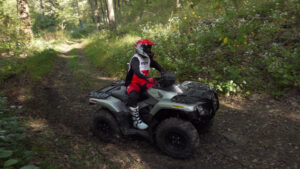
The Honda Rubicon 700 has a legacy for durability. If you want a worker or casual trail cruiser, you could be happy with it. When it comes to performance, the Rubicon seems out of place in this shootout. Honda needs to significantly update it and add a bunch of missing features if they want to make it truly competitive in the 700cc single-cylinder class.
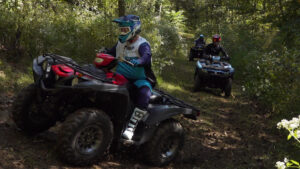
When asked which they’d buy, Isaac said he’d buy the Can-Am due to its stable, predictable steering, great overall suspension, added features for the price, and modern appearance. Landon said he’d be choosing between the Can-Am and the Yamaha. In the end, he said he would go with the Yamaha, believing it would be much easier to work on. He prefers the full steel racks. He also enjoyed its all-around performance highlighted by its light-weight feel with light, agile steering. Aaron chose Yamaha due to its blend of performance and reliable reputation. Plus, it has an assembled-in-the-USA sticker. Casey chose the Yamaha for its fun factor on the trail due to its light, agile, sporty, and planted feeling. Casey believed it would hold up very well in the long run and worked hard enough for his needs. I’d be happy with either the Can-Am or the Yamaha, but the Yamaha’s light, agile, playful demeanor and sport-ATV-worthy brakes simply made it the most fun to ride for me. If I lived in Moab, I’d take the longer-wheelbase Can-Am. In the woods of the Midwest, it’s Grizzly for me.
The bottom line: If you find yourself looking at the 700cc big-bore single-cylinder 4×4 ATV segment, there are many great choices, and one of them is sure to fit your needs best. Hopefully, this shootout will help you make a more informed buying decision.
Category Winners
| Category | Winner | Score |
|---|---|---|
| Engine | Can-Am Outlander XT 700 / Yamaha Grizzly 700 tie | 8.47 |
| Drivetrain | Yamaha Grizzly 700 | 9.00 |
| Suspension | Can-Am Outlander XT 700 | 8.40 |
| Handling | Can-Am Outlander XT 700 | 8.66 |
| Brakes | Yamaha Grizzly 700 | 8.30 |
| Fit and Finish | Can-Am Outlander XT 700 | 8.40 |
| Trail Rider Rating | Yamaha Grizzly 700 | 8.38 |
| Utility Performance | Suzuki KingQuad 750 | 8.14 |
| Final Score | Can-Am Outlander XT 700 | 8.89
|
Rider Rating Breakdown
| Category | Can-Am Outlander XT 700 | Honda Rubicon 700 | Suzuki KingQuad 750 | Yamaha Grizzly 700 |
|---|---|---|---|---|
| Engine | 8.47 (tie best) | 5.57 | 7.77 | 8.47 (tie best) |
| Drivetrain | 8.20 | 6.90 | 8.60 | 9.00 (best) |
| Suspension | 8.40 (best) | 4.04 | 6.48 | 7.72 |
| Handling | 8.66 (best) | 5.86 | 7.09 | 8.46 |
| Brakes | 7.70 | 6.30 | 7.40 | 8.30 (best) |
| Fit and Finish | 8.40 (best) | 7.40 | 7.67 | 8.33 |
| Utility Performance | 7.14 | 6.86 | 8.14 (best) | 6.29 |
| Total Rider Rating | 8.14 (best) | 6.13 | 7.59 | 8.08 |
| Bonus Categories Won | Drag Race, XC, Value | — | Utility | — |
| Final Score With Bonus Points | 8.89 (overall winner) | 6.13 | 7.84 | 8.08 |